
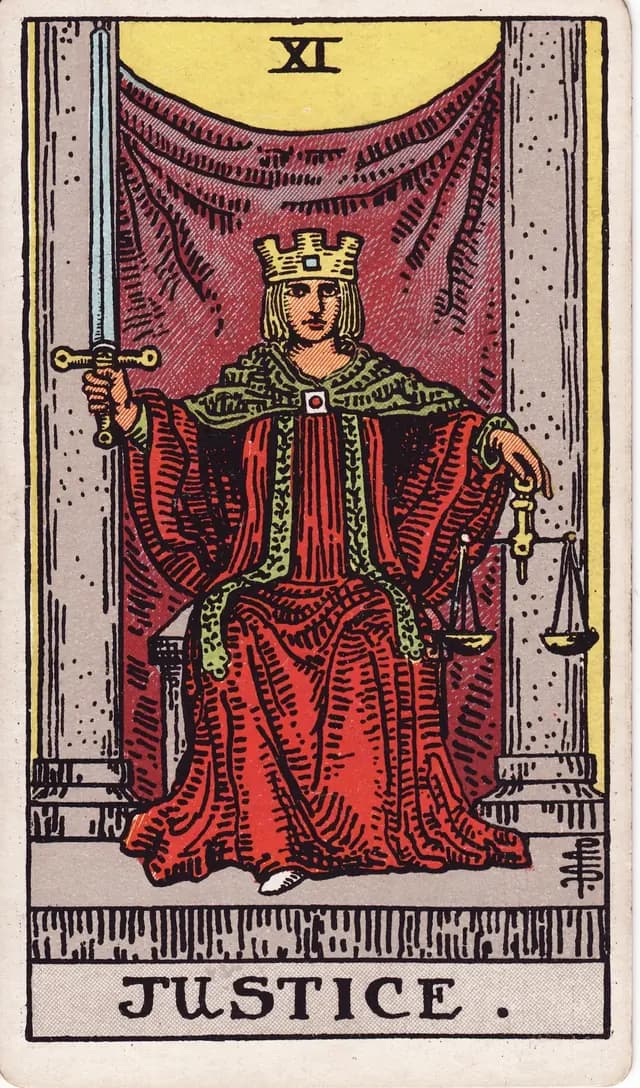
What Justice yes or no means
Upright: Maybe, because your answer depends on honest and fair terms.
Reversed: Leaning no, because your agreement needs a fairer basis.
Justice upright receives Maybe in Naksham's current map, keeping the answer conditional on a fair assessment. The scales invite you to examine the terms rather than decide from preference or pressure alone. Compare what is offered with the responsibility each person would actually accept by saying yes. The reading leaves the choice open while those facts are weighed honestly and the agreement becomes clearer.
Reversed, Justice receives Leaning no because an unresolved imbalance weakens the basis for the proposed choice. Consider accepting another shared task when the earlier division of work was never carried out as agreed. Ask for a correction you can inspect before extending your responsibility under the same unclear terms. The two answers retain their own classifications, without promising that fairness guarantees a particular external result.
Explore Justice with your own draw
Your draw can reveal any card in the deck.
In love
For love, upright Maybe asks whether both people's expectations and contributions have been discussed on fair terms. State what you want from the relationship and invite the other person's answer without demanding a match. Reversed Leaning no highlights a pattern where important needs or promises remain unevenly acknowledged in practice. Use either orientation to examine the actual agreement, leaving affection and consent to the people involved.
At work
At work, upright Maybe supports reviewing the brief, the available support, and how the work will be assessed. Ask whether your responsibility matches the time and authority actually included in the proposed role. Reversed Leaning no draws attention to unclear credit or expectations that one person cannot reasonably meet alone. Resolve the uneven term before treating willingness to help as enough reason to accept another commitment.
Your next step
Write the terms of your question as though both sides needed to understand them before agreeing. Include what each person gives, what each receives, and the choice available if circumstances change. Use upright Maybe to compare those terms and reversed Leaning no to identify a correction still needed. The answer becomes a useful reflection when fair treatment can be described through concrete arrangements and checked actions.
- conditional maybe
- reversed caution
- fair assessment
- honest terms
The image behind this reading
The square clasp sits at the figure's chest as you examine the red robe and green mantle.[1]
Read these meanings as modern interpretations of the imagery in your 1909 Rider-Waite-Smith deck.