
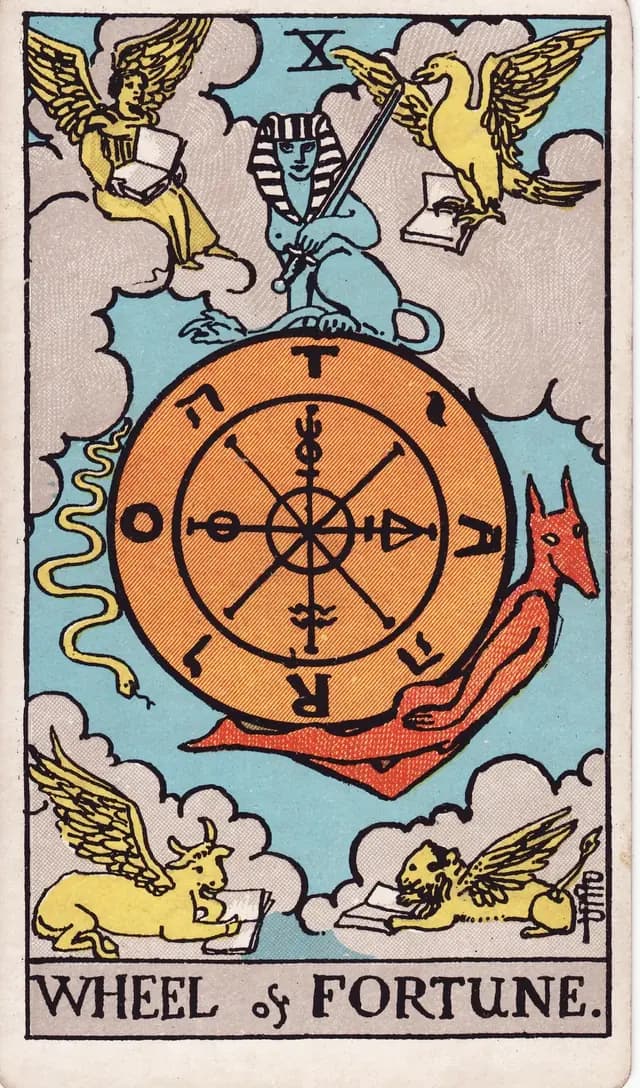
What Wheel of Fortune yes or no means
Upright: Yes, because you can respond to a fresh opening.
Reversed: Leaning no, because your timing and approach need another look.
Wheel of Fortune upright receives Yes in the current map, favoring a response to changing opportunity. Apply that encouragement to an opening you can inspect rather than an imagined stroke of luck. Check the terms and your readiness before deciding how much effort the new possibility deserves. The reading supports movement with a favorable turn, while leaving the eventual outcome open to real conditions.
Reversed, the answer is Leaning no because timing or a repeated approach needs another look. Consider a proposal offered before the people involved can confirm the arrangements it depends upon. Ask which condition needs changing and what alternative remains practical for your own next step. Both orientations concern movement through circumstances, but their separate classifications must not be treated as interchangeable.
Explore Wheel of Fortune with your own draw
Your draw can reveal any card in the deck.
In love
For love, upright Yes supports responding to a real invitation when a connection has room to change. Check whether your hopes match what the other person is offering in the present conversation. Reversed Leaning no asks for attention to repeated difficulties or timing that prevents a workable arrangement. Neither orientation can promise a reunion, establish a destined bond, or replace another person's stated answer.
At work
At work, upright Yes favors exploring an opening whose requirements fit your skills and available time. Ask for the current brief before relying on an earlier description of how the role works. Reversed Leaning no points toward a delay or repeated obstacle that the proposed schedule ignores. Update your plan using confirmed information rather than treating a favorable card as proof of readiness.
Your next step
Phrase the question around responding to one opportunity that is actually available for you to consider. Write the condition that makes the timing useful and the change that would make you pause. Let upright Yes encourage a checked response and reversed Leaning no prompt an adjustment before commitment. Review the real result when it arrives, keeping the symbolic classification separate from what the situation proves.
- upright yes
- reversed caution
- favorable opening
- timing check
The image behind this reading
The blue sphinx holds a sword above the wheel as you examine its still seated shape.[1]
Read these meanings as modern interpretations of the imagery in your 1909 Rider-Waite-Smith deck.