
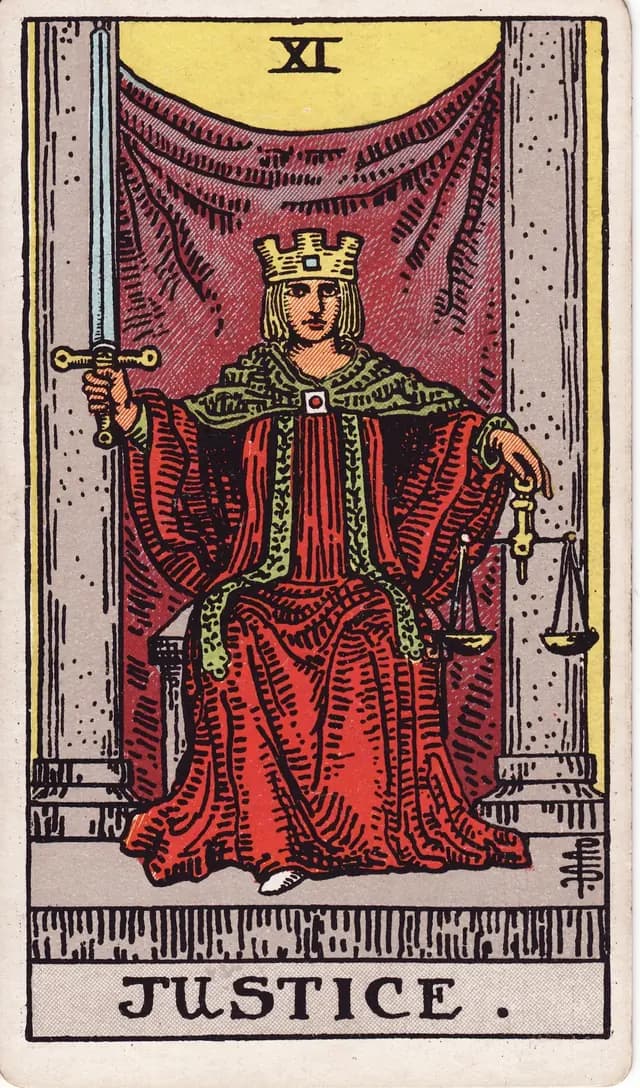
What Justice as a person means
Justice as a person describes someone who weighs decisions carefully and expects words to match chosen responsibilities. This pattern appears through consistent standards, honest corrections, and willingness to hear another side before deciding. Notice how your own fairness becomes visible when the same rule applies even without a personal advantage. The card describes a practice that can change, without declaring anyone morally perfect or permanently impartial.
Picture a teammate noticing that an overlooked contribution belongs in the final account of a shared project. They correct the record even though leaving it unchanged would give their own work more attention. Ask whether your group also makes room for that honesty when the correction involves a mistake. Fairness is most useful when it includes both sharing credit and accepting responsibility for an error.
Explore Justice with your own draw
Your draw can reveal any card in the deck.
In love
As a partner, this pattern values clear expectations and a fair share of ordinary emotional and practical effort. Discuss how your different needs can be met without assuming that equal care always looks identical. Notice whether the person listens to changing circumstances before applying an old agreement as an unchangeable rule. A fair relationship leaves room for kindness while still making important responsibilities clear to both people.
At work
At work, a Justice pattern appears in colleagues who explain decisions and acknowledge the contribution behind the result. Use your attention to standards to make a task clearer, rather than to find fault with every difference. Ask whether the criteria fit the work and are applied consistently across the people being assessed. Helpful fairness gives others a way to understand expectations and correct mistakes without being reduced to them.
Your next step
Choose one decision where your preference differs from the rule you would apply to someone else. Write the reason for that difference and check whether the circumstances truly justify another standard. Ask a trusted person to review the facts if your own involvement makes the comparison difficult. This practices Justice through an honest choice, with room to revise the first judgment when better information arrives.
- fair minded
- clear standards
- honest responsibility
- considered judgment
The image behind this reading
The crowned figure faces forward as you notice one white shoe beneath the folds of the robe.[1]
Read these meanings as modern interpretations of the imagery in your 1909 Rider-Waite-Smith deck.