
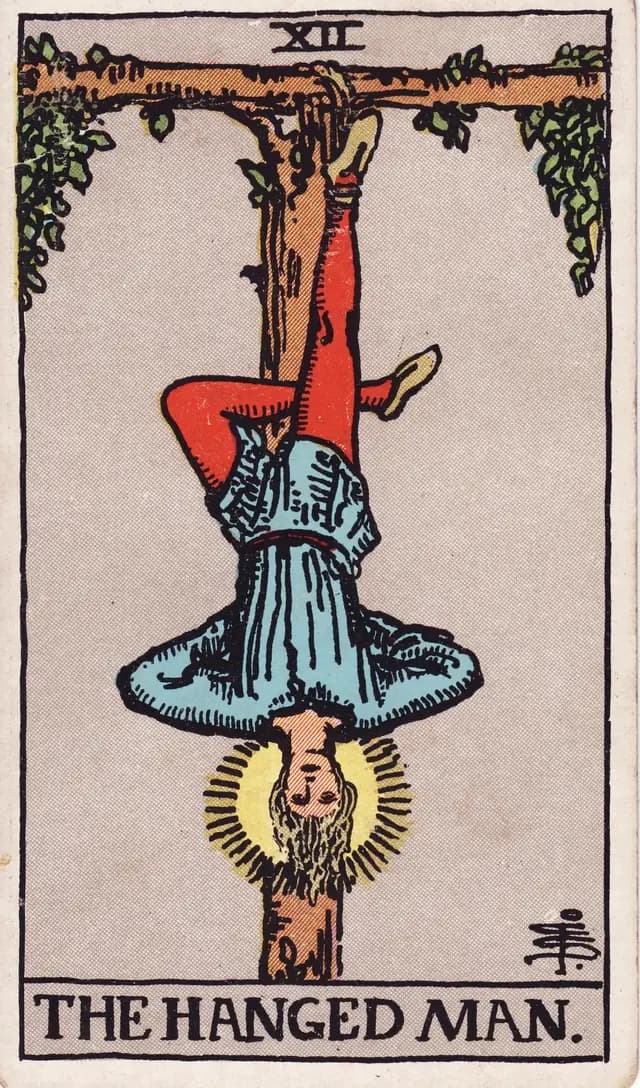
What The Hanged Man yes or no means
Upright: Leaning no, because your next move needs a fresh view.
Reversed: Maybe, because you still need to act on your insight.
The Hanged Man upright receives Leaning no in the current map, favoring a pause before the proposed action. Consider whether your question assumes that more effort must be the only way through a stalled situation. Look for the viewpoint missing from the present plan before adding another commitment to the same approach. The answer suggests reconsideration now, without making delay a permanent verdict on what could become possible later.
Reversed, the classification is Maybe because the pause is shifting toward a decision that still needs careful application. Think of a review that has identified a better question but has not yet tested its practical answer. Choose a small action that uses your new understanding and makes the remaining uncertainty easier to assess. These orientations distinguish a needed pause from readiness still being tested, without automatically reversing the answer.
Explore The Hanged Man with your own draw
Your draw can reveal any card in the deck.
In love
For love, upright Leaning no suggests pausing a repeated attempt to obtain the same answer through more pressure. Ask whether listening to your partner's stated needs would change the question you keep bringing to the conversation. Reversed Maybe leaves room to apply what the pause has shown through a clear, respectful next step. Neither answer overrides a boundary or proves that someone will eventually choose the relationship you want.
At work
At work, upright Leaning no favors reviewing the approach before adding resources to a task that remains blocked. Ask the person using the result what your current process has missed about their actual needs. Reversed Maybe points toward testing the insight from that review before accepting a larger commitment. The practical condition is applying a changed understanding, giving the pause a purpose beyond continued waiting.
Your next step
Ask whether the next proposed action depends on an assumption you have not examined from another position. Write that assumption plainly and find one person or observation that can help you test it. Use upright Leaning no for the review itself and reversed Maybe for carefully applying what became clearer. Keep the real decision tied to what the inquiry reveals rather than expecting the card to supply certainty.
- upright caution
- reversed maybe
- fresh view
- useful pause
The image behind this reading
The leafy branches frame the upper beam as you look along the tree above the hanging figure.[1]
Read these meanings as modern interpretations of the imagery in your 1909 Rider-Waite-Smith deck.