
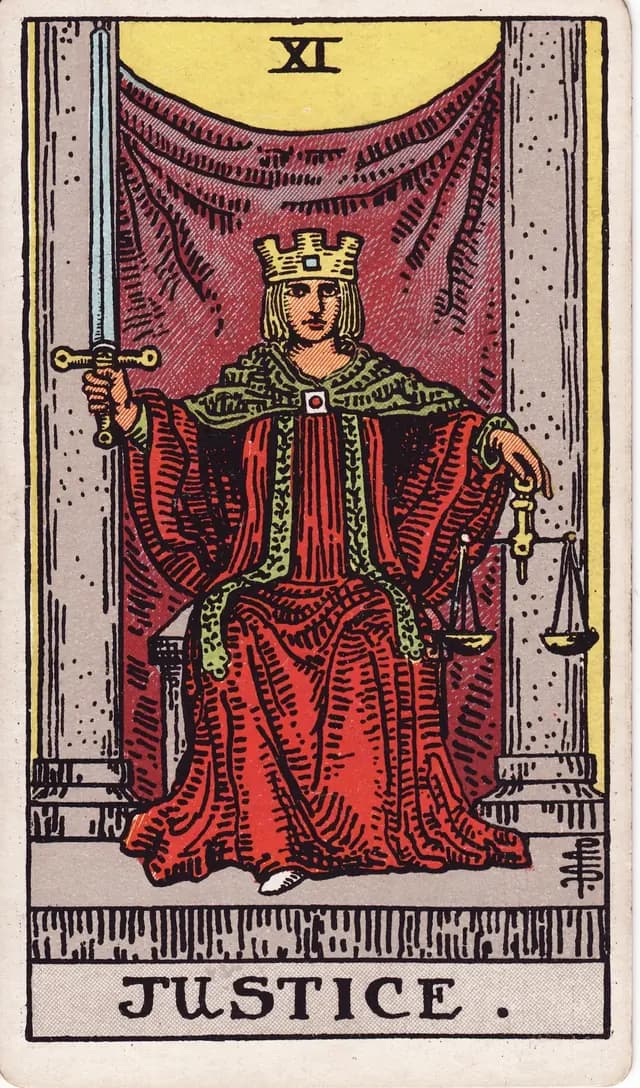
What Justice reversed means
Justice reversed asks you to examine an uneven arrangement or a truth that remains difficult to acknowledge. The concern can involve treatment received, a choice made, or responsibility that nobody has clearly accepted. Compare the agreement with what actually happened before deciding where a correction needs to begin. This reading supports honest repair without assuming that one person must carry all the blame.
Imagine sharing a task equally in theory while one person quietly completes most of the unfinished work. Frustration grows because the spoken agreement no longer matches the effort required in your ordinary week. Bring specific examples to the discussion and ask how the remaining duties can be shared more fairly. A revised arrangement turns the concern into something both people can inspect and choose to change.
Explore Justice with your own draw
Your draw can reveal any card in the deck.
In love
In love, reversed Justice highlights a mismatch between what was agreed and what each person now contributes. Describe the part that feels uneven to you without turning the entire relationship into a list of charges. Ask how time, care, or household tasks can be shared under the circumstances that actually exist. Fairness requires a clear conversation, while the card cannot establish that a partner has lied.
At work
At work, this reversal directs attention toward credit, expectations, or duties that have become unevenly assigned. Keep a factual record of your contribution and compare it with the brief everyone originally accepted. Ask the relevant colleague to clarify ownership before more work disappears into an unspoken assumption. The useful aim is a correction that can be checked, rather than an argument about another person's character.
Your next step
Write the original agreement beside what happened, keeping your observations separate from guesses about why it happened. Identify one correction that would make the arrangement clearer or distribute the effort more fairly. Request that change in plain language and agree on how both people will recognize its completion. Justice reversed becomes useful when a named concern leads to a specific opportunity for honest repair.
- uneven effort
- delayed accountability
- honest correction
- clear agreement
The image behind this reading
The hanging scales sit beside the seated figure as you compare their two small golden pans.[1]
Read these meanings as modern interpretations of the imagery in your 1909 Rider-Waite-Smith deck.