
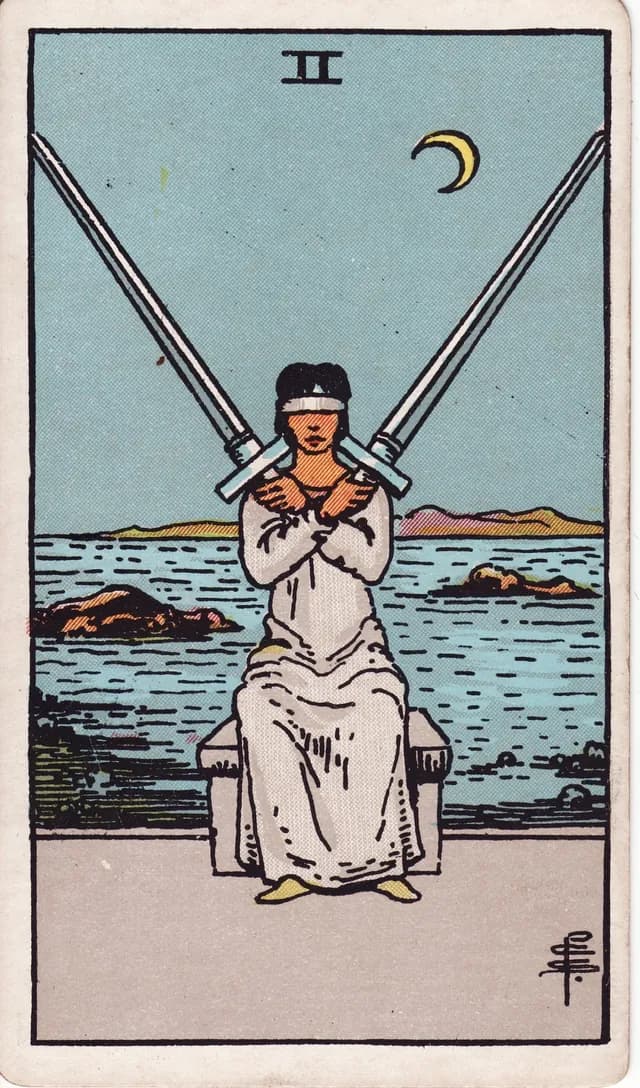
What Two of Swords yes or no means
Upright: Leaning no, because your unresolved choice keeps progress on hold.
Reversed: Maybe, because your choice is clearer but still unfinished.
Upright, the Two of Swords receives Leaning no because an unresolved choice keeps action suspended. Apply this answer to the current conditions around your question, rather than every future possibility. The blindfold and balanced blades suggest that maintaining the standoff has become part of the problem. Before proceeding, identify the fact or tradeoff that nobody has been willing to face.
Reversed, the answer is Maybe as the barrier loosens and the choice begins to emerge. That movement gives you more to work with, without automatically making the proposed action wise. Compare the options using the information now available, including any limits that remain unchanged. Both orientations place the practical condition on facing the decision instead of waiting for certainty.
Explore Two of Swords with your own draw
Your draw can reveal any card in the deck.
In love
For your relationship question, Leaning no reflects the lack of a clear shared choice. Ask what each person is willing to offer before treating a hopeful conversation as agreement. The reversed Maybe allows room for a more direct discussion once the avoided issue surfaces. Neither label replaces consent or establishes what a hesitant person will decide about being together.
At work
A project waiting on an unresolved priority fits the upright Leaning no in this reading. Separate the two competing demands and show your team what each option would require. Reversed Maybe becomes useful when new information lets the decision owner compare those costs more honestly. Approval still needs a named choice, with responsibility assigned before work moves beyond discussion.
Your next step
Rewrite your question so it names the exact decision that must happen before progress. Gather the missing fact, then state the tradeoff that information alone cannot settle for you. Use a deadline appropriate to the situation rather than asking the cards repeatedly for certainty. The Two becomes useful when the next step reduces the standoff in an observable way.
- leaning no
- reversed maybe
- decision needed
- open eyes
The image behind this reading
You can see dark rocks breaking the water behind the blindfolded figure on the stone bench.[1]
Read these meanings as modern interpretations of the imagery in your 1909 Rider-Waite-Smith deck.