
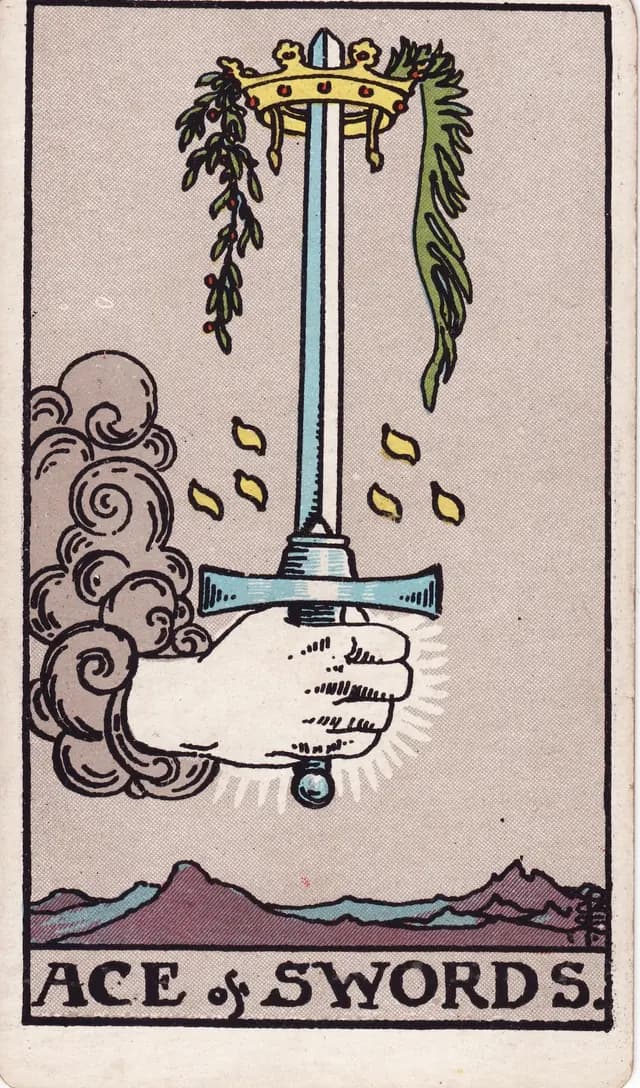
What Ace of Swords yes or no means
Upright: Yes, because your clear thinking supports a sound first step.
Reversed: Leaning no, because your key facts still need checking.
Upright, the Ace of Swords receives Yes in the current map because clarity supports action. Apply that answer to a specific step you can evaluate, such as asking a direct question. The raised blade frames focused thought, with honesty and evidence giving the decision its strength. A favorable classification does not guarantee that everyone will agree with the conclusion you reach.
Reversed, the classification becomes Leaning no because an important part of the picture remains unclear. Compare the two orientations through your evidence, rather than treating reversal as an automatic opposite. A proposal with a checked premise differs from one supported mainly by a persuasive explanation. Name the fact that would make your next step reasonable before relying on either answer.
Explore Ace of Swords with your own draw
Your draw can reveal any card in the deck.
In love
For a question about speaking honestly, the upright Ace supports making a clear request. Choose language that explains your need without demanding that a partner supply a particular answer. Reversed, crossed messages make checking what was actually said more useful than another forceful declaration. Neither orientation establishes attraction or consent, which require direct words and freely chosen behavior.
At work
An upright Yes suits a proposal whose main claim your team can test directly. Bring the evidence, define the first step, and ask for feedback on the actual reasoning. With the reversed Leaning no, identify missing facts before treating a confident pitch as enough. The practical condition is a clear basis for action, rather than certainty about final success.
Your next step
Write a question about one action you control, avoiding several different decisions in one sentence. List the facts that support taking that step and mark the point still uncertain. Use the upright answer to consider a small test when the evidence holds together. If the reversed theme fits better, resolve that uncertainty before making a larger commitment.
- clear yes
- checked facts
- honest choice
- new idea
The image behind this reading
You can follow the blade upward between leafy branches hanging from the open crown.[1]
Read these meanings as modern interpretations of the imagery in your 1909 Rider-Waite-Smith deck.