
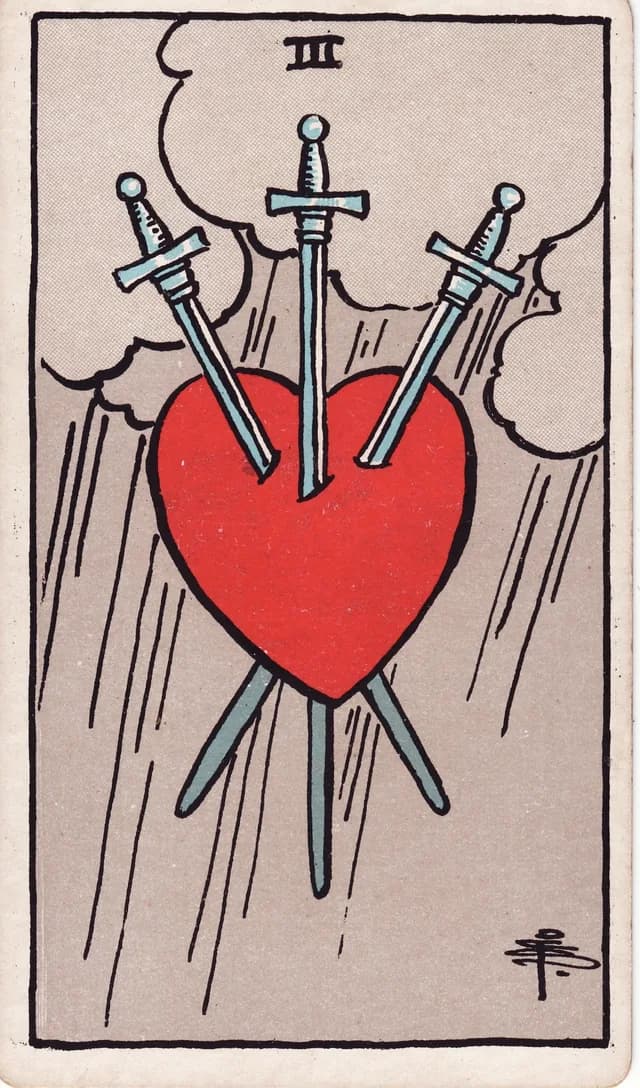
What Three of Swords yes or no means
Upright: No, because your present hurt needs care before commitment.
Reversed: Maybe, because your hurt needs time before another commitment.
Upright, the Three of Swords receives No in the current map because hurt dominates the situation. Apply that classification to your proposed step under present conditions, without extending it into a permanent forecast. The image asks you to acknowledge the painful issue rather than use action to escape it. A clear refusal can leave room for care, reflection, and a more honest assessment.
Reversed, the classification is Maybe as the relationship with that hurt begins to change. A softer response gives you room to consider a step, without proving the original concern has disappeared. Check whether the relevant boundary, expectation, or broken agreement has actually received attention before proceeding. The practical condition is readiness grounded in circumstances, rather than a wish to stop feeling disappointed.
Explore Three of Swords with your own draw
Your draw can reveal any card in the deck.
In love
For a question about renewed closeness, upright No asks you to acknowledge the unresolved hurt first. That does not decide the future of the relationship or establish what another person wants. Reversed Maybe leaves room for discussion when both people freely agree and the concern is addressed. Keep consent, actual behavior, and your own limits central when deciding whether contact feels appropriate.
At work
A painful rejection can make an immediate new commitment feel like a way to prove yourself. The upright No invites you to examine that pressure before accepting another demanding task. Reversed Maybe suits a more considered review once the disappointment no longer drives the whole decision. Check the actual workload and agreement, allowing practical facts to guide what you take on.
Your next step
Ask whether your proposed action addresses the issue or simply distracts from its emotional weight. Write down the concern that would remain even if the hoped for outcome arrived tomorrow. Choose a smaller step that respects that concern, such as requesting clarity or setting a boundary. The Three becomes useful when the answer leads to care for the situation actually present.
- present no
- reversed maybe
- painful truth
- care first
The image behind this reading
You see three separate sword hilts above the pierced heart under the heavy bank of clouds.[1]
Read these meanings as modern interpretations of the imagery in your 1909 Rider-Waite-Smith deck.