
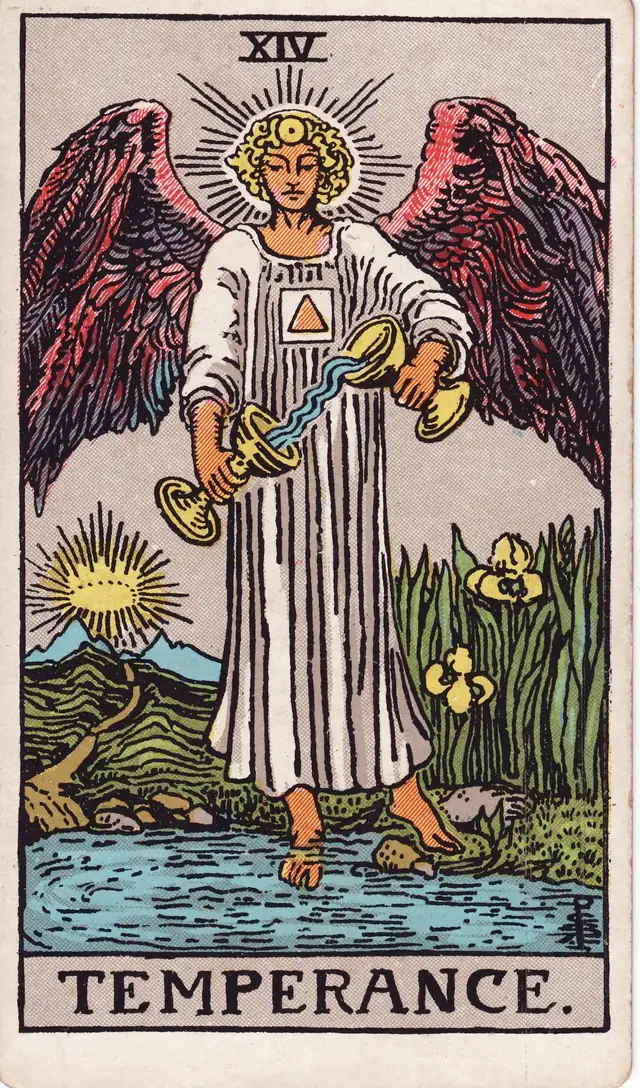
What Temperance yes or no means
Upright: Maybe, because your plan needs patience and a steady balance.
Reversed: Leaning no, because your pace and balance need adjusting.
Temperance upright receives Maybe in Naksham's current map, preserving an answer that depends on patience and workable balance. The card's calm image does not turn that conditional answer into a firm Yes for your question. Check whether the proposed pace allows the different needs involved to receive enough practical attention. The reading supports careful adjustment while leaving the final decision open until the arrangement can be assessed honestly.
Reversed, the label is Leaning no because rushing or uneven effort makes the current proposal difficult to sustain. Consider adding another meeting when your schedule already leaves important agreed work without enough time to be completed. Reduce the excess or change the pace before asking the same arrangement to carry another demand. The orientations preserve different answers while both direct attention toward the proportion and timing of the actual plan.
Explore Temperance with your own draw
Your draw can reveal any card in the deck.
In love
For love, upright Maybe asks whether closeness can grow at a pace both people understand and choose freely. Discuss how your needs for contact and separate time fit the arrangement currently being offered between you. Reversed Leaning no highlights an imbalance or pressure that needs adjusting before a further commitment is added. Neither orientation confirms a partner's feelings or makes waiting indefinitely a requirement for proving that the connection matters.
At work
At work, upright Maybe asks whether available skills can combine at a pace the team can maintain. Ask where your schedule needs feedback instead of expecting the first version to satisfy every requirement immediately. Reversed Leaning no points toward excess, rushing, or effort concentrated in the wrong part of the task. A practical correction should make the next step more proportionate before the team accepts another demand.
Your next step
Ask about an arrangement whose pace and balance you can review directly with the people involved. Name each necessary contribution and the point where your plan gives one demand too much room. Use upright Maybe for a measured trial and reversed Leaning no to correct an imbalance before proceeding further. Let the result of that adjustment inform your decision instead of turning patient imagery into a promised outcome.
- upright maybe
- reversed caution
- balanced trial
- patient pacing
The image behind this reading
The triangle inside a square appears on the robe as you look below the angel's face.[1]
Read these meanings as modern interpretations of the imagery in your 1909 Rider-Waite-Smith deck.