
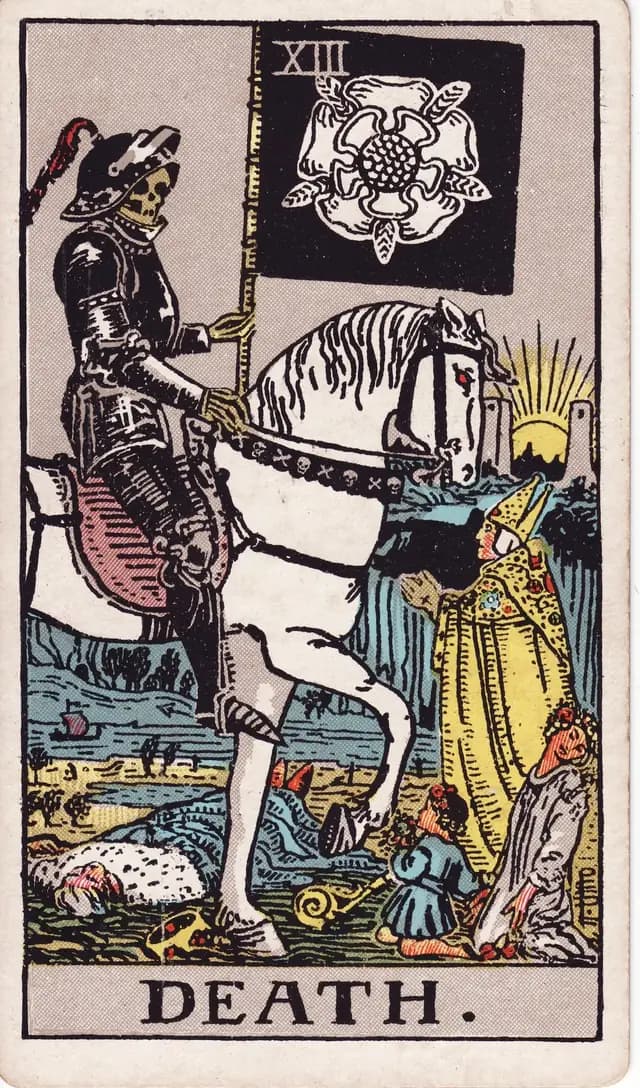
What Death yes or no means
Upright: No, because your old chapter needs a clear ending.
Reversed: Maybe, because you are still working through a needed ending.
Death upright receives No in the current map, linking the answer with closure rather than continuing unchanged terms. Examine whether your question asks an outgrown arrangement to keep serving a purpose it no longer meets. Name what has ended or needs ending before deciding how the next choice should be framed. This reading concerns a chapter of life, without predicting physical death or any event from the card's name.
Reversed, the classification is Maybe because release remains unfinished and the next arrangement is still taking shape. Consider renewing a commitment simply because you have not yet communicated that its purpose has changed. Complete the necessary conversation before deciding whether anything should continue under different terms that fit your present needs. Both orientations concern transition, while their answers distinguish closure from difficulty releasing an old form of the arrangement.
Explore Death with your own draw
Your draw can reveal any card in the deck.
In love
For love, upright No asks whether continuing the relationship depends on a pattern that needs to end. Clarify the specific arrangement your question concerns instead of treating the label as an order to leave someone. Reversed Maybe highlights attachment to old terms while the actual future remains unsettled between the people involved. A conversation about present choices matters more than trying to read another person's final decision from this card.
At work
At work, upright No points toward a chapter or process whose present form no longer deserves continuation. Check which duties still need completing before your team can close that part of the work responsibly. Reversed Maybe asks whether a delayed handover or attachment to a familiar task is keeping the transition unclear. Finish the practical closing step before committing fresh effort to terms that no longer fit the project.
Your next step
Write what continuing would require and compare that with the reason the arrangement originally mattered to you. Identify what has run its course without assuming every connected person or activity must also be released. Use upright No to name closure and reversed Maybe to examine what still makes letting go difficult. Choose a concrete ending step whose effect can be understood without demanding a guaranteed replacement in advance.
- upright no
- reversed maybe
- closing chapter
- unfinished release
The image behind this reading
The distant sun appears between two towers as you look beyond the horse toward the river.[1]
Read these meanings as modern interpretations of the imagery in your 1909 Rider-Waite-Smith deck.