
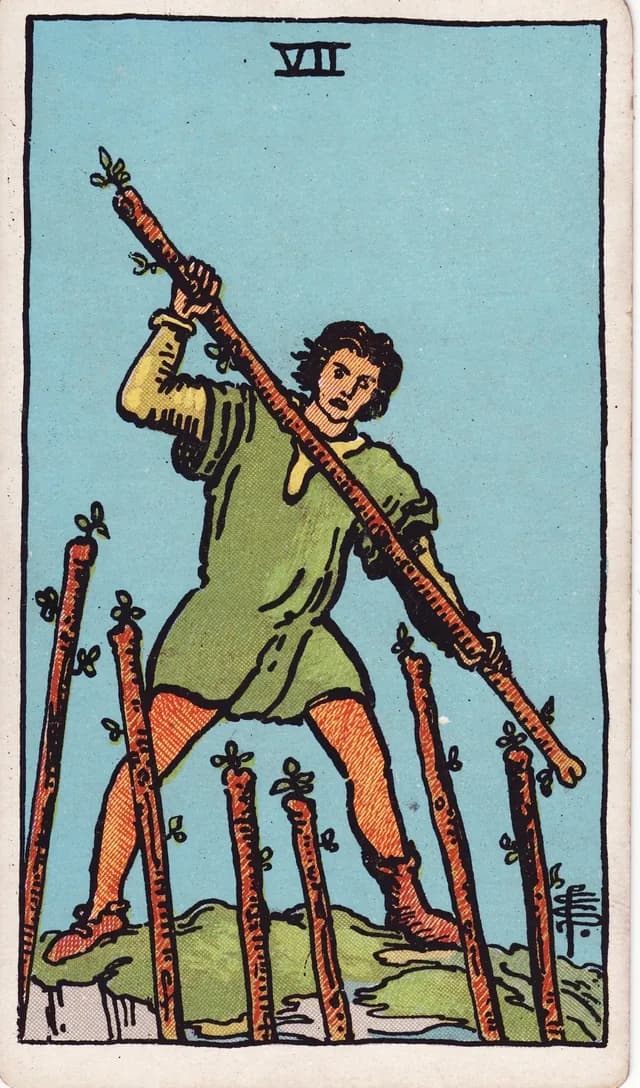
What Seven of Wands yes or no means
Upright: Maybe, because your position needs steady support under pressure.
Reversed: Leaning no, because this constant defense is draining your energy.
The Seven of Wands upright receives Maybe in the current map, keeping the answer conditional under pressure. A strong position still needs enough support to withstand the challenges relevant to your actual question. The figure on higher ground gives the reading an image of holding a place that requires effort. Check what must be defended and whether the purpose justifies that effort before deciding to proceed.
Reversed, the live answer is Leaning no because constant defense leaves too little energy for a useful response. Ask whether your next action would protect something important or simply extend a contest that no longer helps. A reduced scope or clear exit can leave room for the responsibility that matters more now. The two labels preserve the difference between a defensible position and a fight whose cost needs closer review.
Explore Seven of Wands with your own draw
Your draw can reveal any card in the deck.
In love
For love, upright Maybe asks whether both people want to maintain the boundary the relationship currently needs. Check that your support respects your partner's choices and does not substitute outside pressure with pressure from within. Reversed Leaning no points toward a defensive pattern that is tiring the connection rather than serving it. Discuss the actual issue before treating either answer as a prediction that the relationship will last or end.
At work
At work, upright Maybe suits defending a proposal when the evidence and responsibility for doing so are clear. Check your capacity to answer relevant questions without abandoning the work the proposal is meant to support. Reversed Leaning no asks whether another round of defense would repeat a costly and unhelpful pattern. Consider a narrower commitment or a formal decision process before taking personal responsibility for every challenge again.
Your next step
Phrase the question around holding one specific position rather than winning against everyone who disagrees with you. Identify the evidence, support, and effort that this boundary would require in the present situation. Use upright Maybe to assess whether those conditions make continued defense a reasonable choice. With reversed Leaning no, review the cost before promising further effort to a contest that already feels draining.
- upright maybe
- reversed leaning no
- conditional support
- defensible position
The image behind this reading
You can see six upright staffs reaching toward the figure from below the raised ground.[1]
Read these meanings as modern interpretations of the imagery in your 1909 Rider-Waite-Smith deck.