NakshamNAKSHAM
Tarot
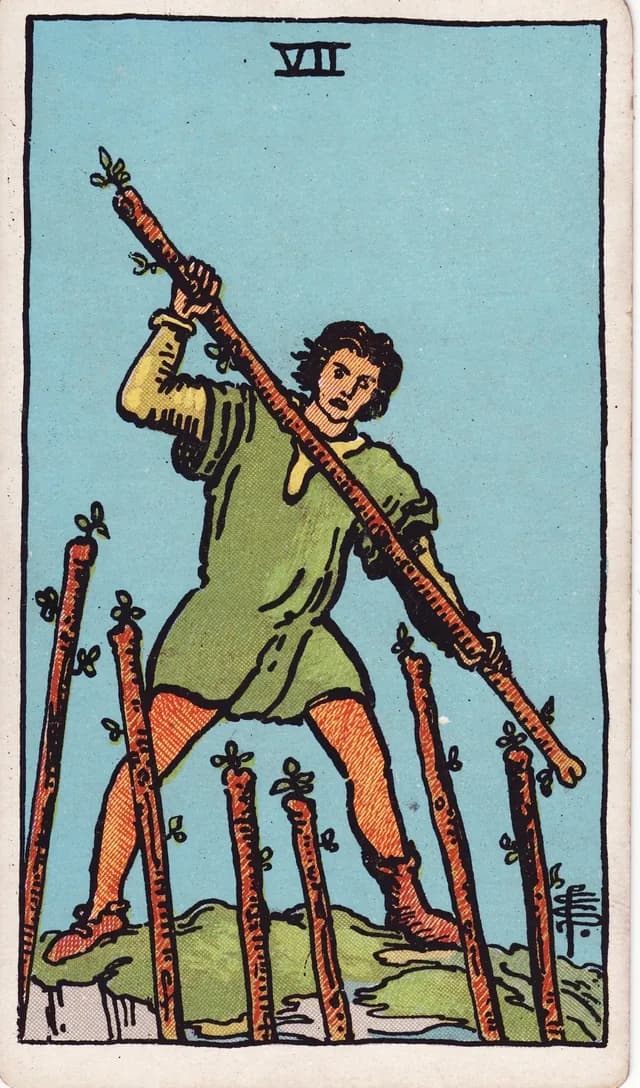
Seven of Wands in the Rider-Waite-Smith deck, reversed

Seven of Wands Reversed

Reversed

What Seven of Wands reversed means

The Seven of Wands reversed describes a tiring defense that has stopped serving a useful purpose. Constant replies and repeated explanations can consume energy your actual priorities still need elsewhere. Ask which boundary matters now and which argument continues mainly because it has become familiar. Choose the position worth defending and consider leaving a contest whose purpose no longer justifies its demands.

A group keeps reopening a settled decision, and each comment pulls you back into another reply. Check whether another explanation could change anything before spending the evening restating the same point. Give one clear account of your limit and decide how further requests will be handled. Stepping away becomes a chosen boundary when the practical arrangement is clear rather than an exhausted disappearance.

Explore Seven of Wands with your own draw

Your draw can reveal any card in the deck.

Get your own yes or no answer

Explore your question in a love reading

In love

In love, this reversal highlights the tiredness of treating every difference as something the bond must defend against. Ask whether your partner is actually challenging the relationship or requesting a change within it. A calmer conversation can separate outside pressure from a need that deserves attention between the two of you. Keep the boundary that matters while letting go of arguments that have stopped helping either person feel understood.

At work

At work, the reversed Seven highlights effort spent defending decisions that no longer justify constant debate. Review which questions need your expertise and which can be handled through an agreed process. Ask the team to record settled decisions so every new comment does not restart the same discussion. Saving attention for the strongest priority can be more useful than trying to answer every challenge personally.

Your next step

List the issues you are currently defending and mark the one whose outcome still matters most. Ask what practical action would serve that priority better than another round of explanation. Set a clear limit on the remaining debates and tell affected people how decisions will proceed. Review the result after a short interval, allowing your boundary to change if the facts or responsibilities change.

  • tired defenses
  • chosen battles
  • released pressure
  • clear limits

The image behind this reading

Notice the uneven ground beneath the standing figure as you trace the narrow stream between the feet.[1]

Read these meanings as modern interpretations of the imagery in your 1909 Rider-Waite-Smith deck.

Show source

This line sums up your reading of this card.

These meanings are modern readings of the card art.

Frequently Asked Questions

Is Seven of Wands reversed a yes or no?+
Leaning no, because this constant defense is draining your energy. The current map points away from continuing a contest whose demands outweigh its present purpose. Identify the boundary that still matters before deciding how much more effort the situation deserves. Reducing the number of active disputes leaves your main responsibilities with more time and attention to develop properly.
Does stepping back mean you have lost your position?+
Stepping back from an argument does not automatically change the agreement or responsibility that defines your actual position. Check the practical facts before treating fewer replies as a surrender of everything you value. State the boundary clearly and use the process available for questions that still need a decision. Choose from those facts, giving the commitment its required care without answering every comment that surrounds it.
How do you choose which battle still matters?+
Choose by the effect on your responsibilities and values rather than by how loudly another person keeps objecting. Ask what would actually change if you stopped replying to that particular point today. Focus on the decision with real consequences and leave settled arguments outside the next conversation. The reversed Seven directs effort toward purpose instead of treating every challenge as equally deserving of defense.
What if lowering your guard feels uncomfortable at first?+
A habit of replying quickly can make even a reasonable pause feel like neglecting something important. Begin with one low-stakes discussion where your position is already clear and no immediate response is required. Notice what actually happens before deciding that every silence invites another person to take over. Keep essential responsibilities covered during this experiment, so the pause tests a habit without neglecting an agreed commitment.
Is Seven of Wands reversed a bad card?+
No tarot card is bad in itself. Seven of Wands reversed shows the shadow side of the card, offered as guidance rather than a verdict. Reversed, it suggests: Always being on guard is wearing you down. Ask yourself one honest thing. Is this fight truly worth it? Some spots are okay to let go. Then your drive goes to something better. Read it as a prompt to reflect, not a cause for alarm.

Related Pages

Sources & References

  1. [1]Pamela Colman Smith and A. E. Waite, Rider-Waite-Smith tarot deck (1909)