
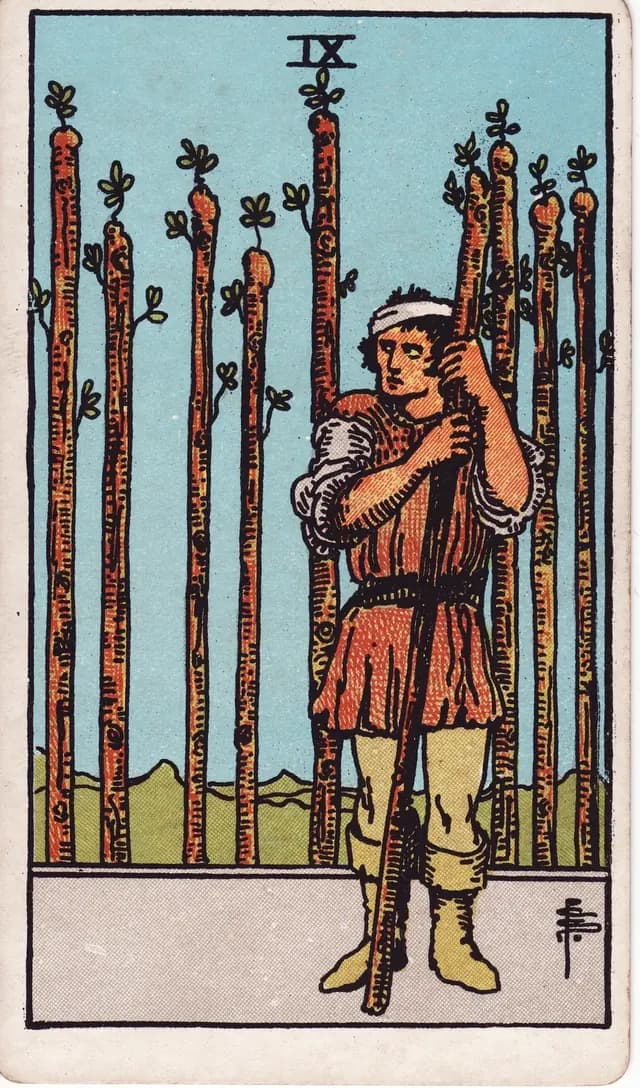
What Nine of Wands yes or no means
Upright: Maybe, because your next push needs strength and clear limits.
Reversed: Leaning no, because your tired guard needs rest before another push.
The Nine of Wands upright receives Maybe in Naksham's current map, keeping the answer conditional. Its standing figure suggests remaining strength alongside the strain of a long demanding effort. Check whether your proposed next step has a clear endpoint and enough available support. The practical question is whether another push serves the goal without assuming that tiredness must always be overcome.
Reversed, the current answer is Leaning no because keeping the guard raised has become exhausting. Pause before adding your time to another round that repeats the same unsupported demand. Confirm what rest, cover, or revised scope would change the conditions of the decision. Both orientations ask about capacity, while preserving the map's difference between a conditional opening and a present limit.
Explore Nine of Wands with your own draw
Your draw can reveal any card in the deck.
In love
For love, upright Maybe asks whether continuing includes real care and an agreement both people can sustain. Discuss your present willingness instead of treating the time already invested as a reason to stay. Reversed Leaning no points toward exhausted defenses that need attention before another demanding exchange. Neither classification settles another person's feelings, so consent and clear conversation remain part of the decision.
At work
At work, upright Maybe suits a final effort whose scope and resources still need checking. Name your remaining task and confirm what help is available before accepting another deadline. Reversed Leaning no discourages repeating an arrangement that already leaves the team worn down. A reduced scope or planned handoff provides relevant evidence for the choice, without changing the card's stored classification.
Your next step
Frame the question around one defined commitment instead of asking whether persistence always pays off. Write down your available time, the stopping point, and what makes the effort worthwhile. With upright Maybe, resolve the missing condition before agreeing to continue the next stage. With reversed Leaning no, make room for rest and review the demand before taking on anything further.
- upright maybe
- reversed leaning no
- remaining strength
- bounded effort
The image behind this reading
Look at the staff between the figure's boots as you follow the hands gripping it.[1]
Read these meanings as modern interpretations of the imagery in your 1909 Rider-Waite-Smith deck.