
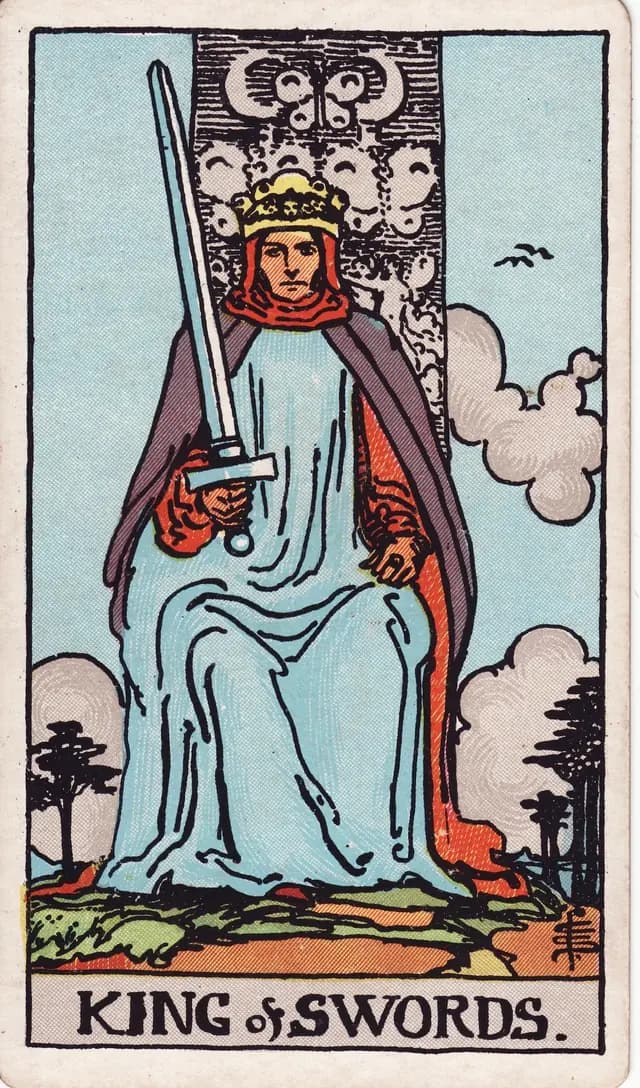
What King of Swords yes or no means
Upright: Maybe, because you need stronger evidence for a fair decision.
Reversed: Leaning no, because your decision needs a fairer process.
The King of Swords reads as Maybe upright, asking for stronger evidence before your final decision. A confident speaker or carefully worded proposal does not settle the practical question on its own. Gather the facts that matter to your decision and apply the same standard to each option. The useful condition is a fair basis for choosing, rather than pressure to produce an immediate answer.
Reversed, the label becomes Leaning no because the decision process can become cold, rigid, or uneven. Examine whether your preferred outcome is receiving special treatment while opposing evidence gets dismissed. Ask who can question the terms and whether an objection receives a reasoned response. A fair review improves the basis of the choice, but no card can guarantee the result afterward.
Explore King of Swords with your own draw
Your draw can reveal any card in the deck.
In love
For love questions, upright Maybe asks whether both people have clearly stated what they can offer. Listen for an agreement that gives your needs and the other person's needs equal weight. Reversed Leaning no draws attention to rules imposed through argument instead of freely shared understanding. A useful condition is mutual agreement in practice, including the right to decline without being debated into consent.
At work
At work, the king's Maybe calls for evidence that meets a clear and consistently applied standard. Request the information needed to judge the proposal before your name becomes attached to it. Reversed Leaning no asks whether rank or personal preference has replaced a fair decision process. Keep the discussion specific to criteria and consequences, and seek an explained review where the process allows one.
Your next step
Define your decision, then write the standard that would make either option reasonable to choose. Gather one relevant fact from a source you can check before comparing the available choices. The king's clear judgment works best when the rule is set before the preferred outcome. If the process remains uneven, pause your agreement and name the condition needed for a fair decision.
- upright maybe
- reversed leaning no
- stronger evidence
- equal standards
The image behind this reading
You can see two small birds in the blue sky to the right of the throne.[1]
Read these meanings as modern interpretations of the imagery in your 1909 Rider-Waite-Smith deck.