
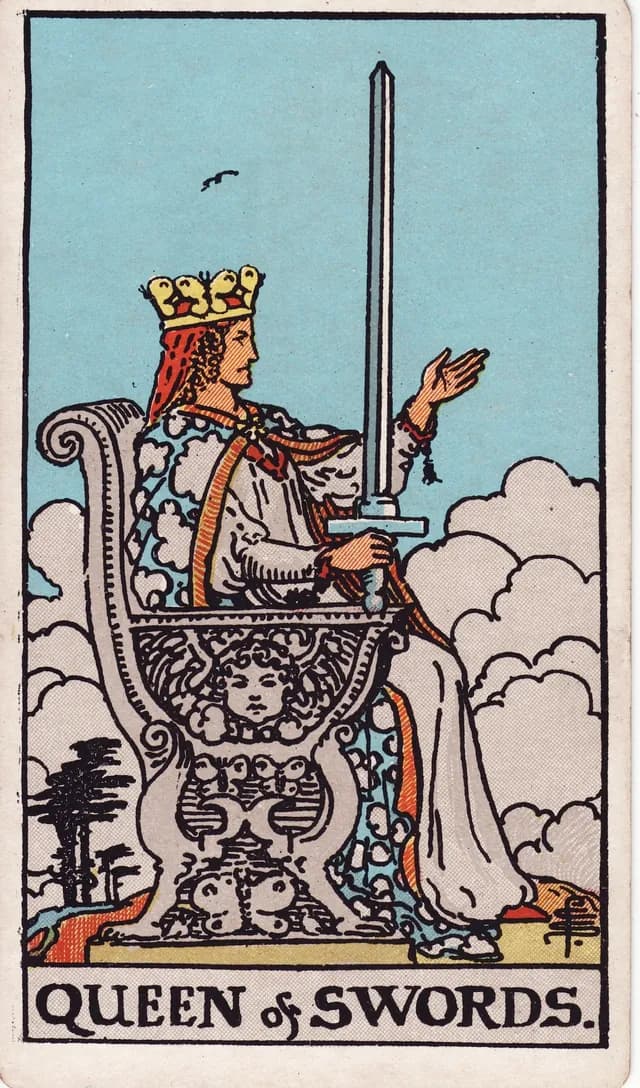
What Queen of Swords yes or no means
Upright: Maybe, because you need the full truth before choosing.
Reversed: Leaning no, because your judgment needs a kinder view.
The Queen of Swords reads as Maybe upright, calling for a fuller picture before your decision. Clear thinking helps you ask the right question, but it cannot replace facts still missing. Separate what someone has shown from what you hope their words are meant to imply. The practical condition is enough honest information to make your choice without filling the gaps yourself.
Reversed, the classification becomes Leaning no because harsh judgment can narrow the view of your options. Past disappointment can make a reasonable question sound like a charge someone must answer. Review the facts that support your position and those that challenge it with equal care. A calmer assessment improves the choice process, while the card does not promise a favorable outcome.
Explore Queen of Swords with your own draw
Your draw can reveal any card in the deck.
In love
For a relationship question, upright Maybe asks whether direct conversation has established what both people want. Ask about commitment or contact in terms that your partner can answer without guessing. Reversed Leaning no points toward criticism or guarded judgment that prevents a fair exchange. Base your next step on the answer and behavior, rather than using sharp questions to force closeness.
At work
For work, the queen's Maybe supports reviewing the brief before agreeing to an unclear assignment. Request the scope, deadline, and decision owner so your acceptance has a sound basis. Reversed Leaning no warns against making the call while irritation turns feedback into personal judgment. A fair review names the actual missing requirement and gives a concrete route to resolve it.
Your next step
Write your question as one decision you control, with a condition that can be checked. List the missing fact that would most change your answer, then seek it directly. The queen's upright sword suggests precision, so remove side arguments that do not affect that choice. Revisit the decision after the information arrives, keeping the card's current classification separate from factual proof.
- upright maybe
- reversed leaning no
- complete facts
- fair assessment
The image behind this reading
You see a single bird high above the queen, left of the tall vertical sword.[1]
Read these meanings as modern interpretations of the imagery in your 1909 Rider-Waite-Smith deck.