
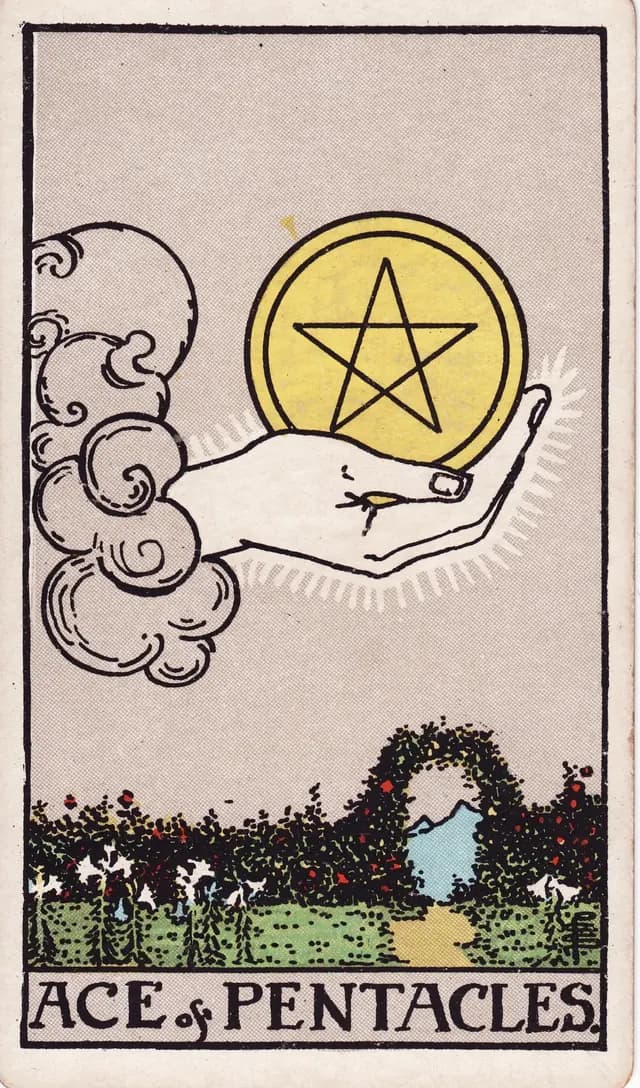
What Ace of Pentacles yes or no means
Upright: Yes, because you have a solid chance to begin.
Reversed: Leaning no, because your new start lacks firm support.
Upright, the Ace of Pentacles gives your question a Yes in Naksham's current card classification. The offered coin supports a practical beginning that has something tangible available to work with. Match the answer to a small action whose requirements you can see and understand. Treat it as encouragement to assess an opening, without making the card a guarantee of success.
Reversed, the same card receives Leaning no because the new start lacks firm practical support. Missing tools, unclear terms, or a premature deadline can prevent your opening from taking root. Check the actual obstacle before deciding whether a pause or a different beginning serves you. Both answers concern the quality of the foundation, rather than certainty about what will happen afterward.
Explore Ace of Pentacles with your own draw
Your draw can reveal any card in the deck.
In love
For a question about starting contact, the upright answer supports a clear, respectful invitation. Keep the invitation simple enough that the other person can freely give you an answer. Reversed, review whether timing and mutual availability support the meeting before pressing for a date. Neither orientation confirms another person's love, so shared willingness remains the practical condition for any beginning.
At work
A question about beginning a project fits the Ace when its basic resources are present. The upright Yes supports taking your first defined step after checking access and expectations. Reversed Leaning no directs attention toward what is missing before the work can start well. Use the actual project details to make the decision, with this card framing the readiness question.
Your next step
Write your question around one beginning rather than the eventual success of an entire venture. List the materials, time, and agreement needed to take that first step in practice. Compare those requirements with what is already available before relying on the encouraging upright answer. If the card is reversed, name the missing support and choose a specific way to check it.
- upright yes
- reversed caution
- ready beginning
- practical condition
The image behind this reading
You can trace the five pointed star inside the coin held over the green garden.[1]
Read these meanings as modern interpretations of the imagery in your 1909 Rider-Waite-Smith deck.