
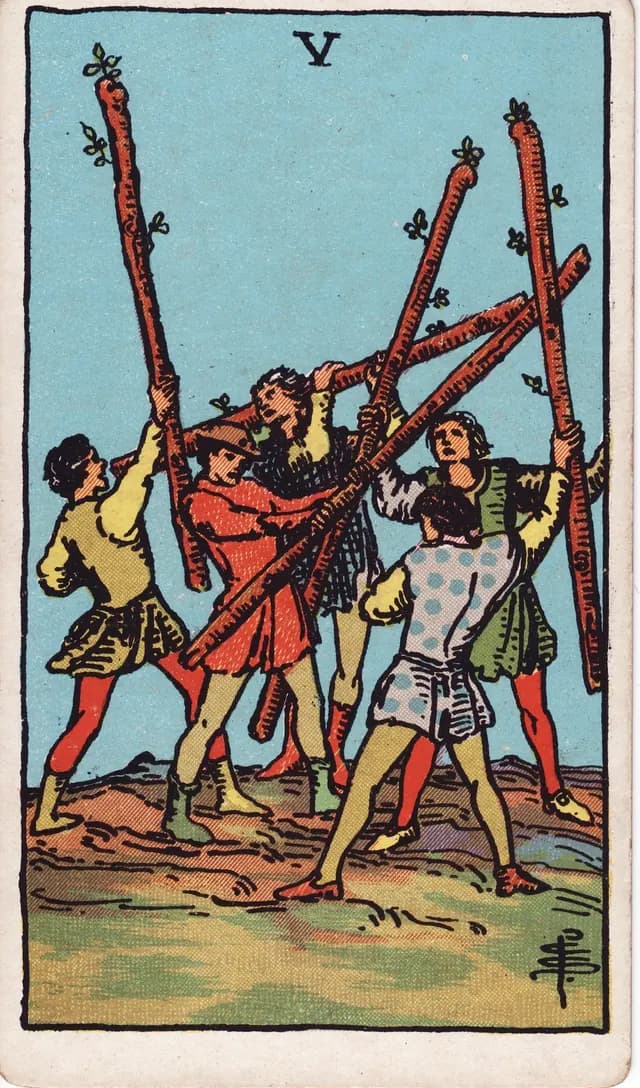
What Five of Wands yes or no means
Upright: Leaning no, because your competing aims need a shared direction.
Reversed: Maybe, because your quieter situation still needs a clear agreement.
The Five of Wands upright receives Leaning no in the current map because competing aims create friction. Before proceeding, check whether the people involved agree on what your next step is meant to achieve. The staffs pointing in different directions give the reading an image of effort without a shared approach. A fair decision process is the practical condition for considering movement beyond the current clash of priorities.
Reversed, the live answer is Maybe because quieter conflict still leaves the outcome unsettled. Ask whether your group has reached a real agreement or simply stopped discussing the difference. A pause can help when people use it to prepare a clearer and more focused conversation. The two labels preserve the distinction between active friction and a quieter situation whose next direction remains open.
Explore Five of Wands with your own draw
Your draw can reveal any card in the deck.
In love
For love, upright Leaning no asks for attention to clashing needs before adding another shared commitment. Check whether your partner understands the same goal and feels heard in the discussion about it. Reversed Maybe leaves room for progress after the argument cools, without assuming the disagreement has disappeared. Decide from the agreement reached, leaving another person's affection for them to express through words and care.
At work
At work, upright Leaning no suits a proposal pulled between rival priorities or unclear rules for deciding. Ask which objective your team is serving before investing further effort in incompatible versions of the task. Reversed Maybe calls for checking whether quieter meetings reflect agreement or only reluctance to object. Record the decision and responsibilities so the project has a clear direction after the meeting ends.
Your next step
Frame your question around proceeding with one disputed action rather than whether every disagreement will disappear. List the competing aims and identify the person responsible for making the next clear decision. For upright Leaning no, seek alignment before committing additional effort to the contested approach. For reversed Maybe, confirm the settled points and return to any difference still blocking the next action.
- upright leaning no
- reversed maybe
- competing aims
- shared direction
The image behind this reading
You can see the spotted tunic on the foreground figure beside two crossing wooden staffs.[1]
Read these meanings as modern interpretations of the imagery in your 1909 Rider-Waite-Smith deck.