
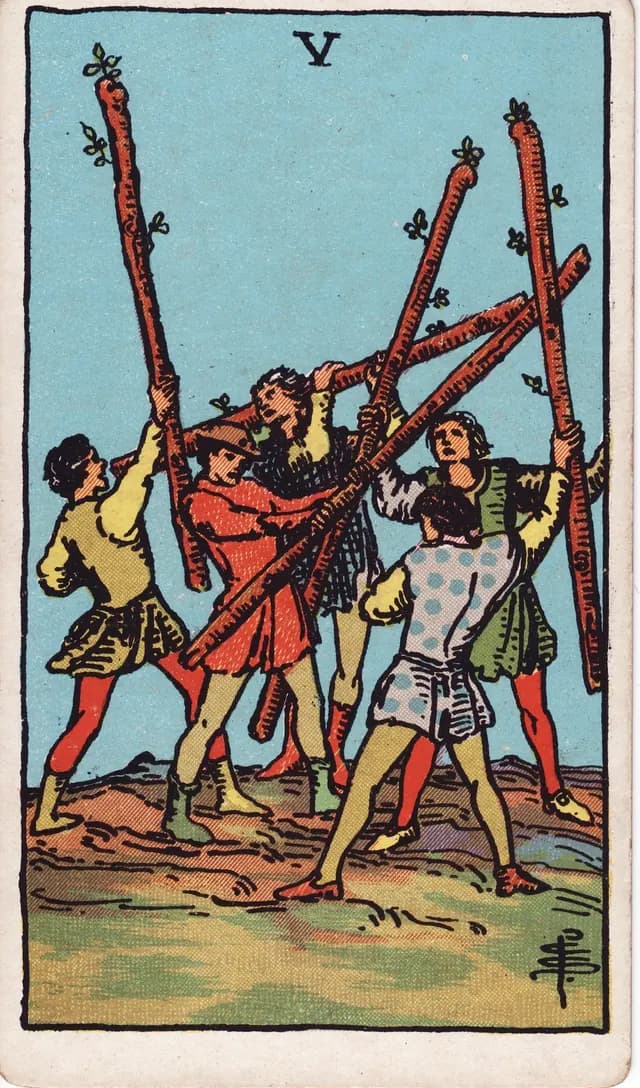
What Five of Wands as a person means
The Five of Wands as a person describes someone who engages through debate, competition, and testing different approaches. This pattern brings energy to a group when disagreement stays focused on the shared task. Notice whether your own challenges invite stronger ideas or simply make others defend every contribution. Fairness and listening shape this changeable habit, giving the group's active energy a more useful direction.
A friend enjoys comparing strategies during a game and asks everyone to explain their choices. The exchange stays lively because your group agrees on the rules and can laugh at mistakes. Watch whether the same person accepts losing or insists on changing the terms after another player succeeds. Their response shows how the competitive habit works more clearly than the enthusiasm they bring at the start.
Explore Five of Wands with your own draw
Your draw can reveal any card in the deck.
In love
As a partner, this pattern can bring lively discussion and a willingness to voice different needs. Share your preferences clearly and notice whether disagreement still leaves room for care and ordinary affection. Constant challenge becomes tiring when every small choice requires a debate that someone must win. Honest engagement includes accepting simple differences, so both people can express a preference without preparing another argument.
At work
At work, a Five pattern questions assumptions and enjoys comparing rival ideas against practical demands. Invite that person to test your proposal against clear criteria rather than criticize without a defined purpose. Ask them to contribute a possible improvement whenever they identify a weakness in the current approach. Keep the contest focused on improving the work, with space for colleagues to contribute without personal pressure.
Your next step
Choose one discussion where challenging an assumption would help the group make a clearer decision. Explain your concern with a specific example and invite the same scrutiny of your own suggestion. Practice accepting a stronger alternative without needing to add another objection just to remain involved. Testing ideas becomes a useful skill when the group can adopt the strongest option without a personal score.
- active challenger
- competitive spirit
- lively debate
- fair participation
The image behind this reading
Compare the spread feet of the foreground figure as you follow the staff across the body.[1]
Read these meanings as modern interpretations of the imagery in your 1909 Rider-Waite-Smith deck.