
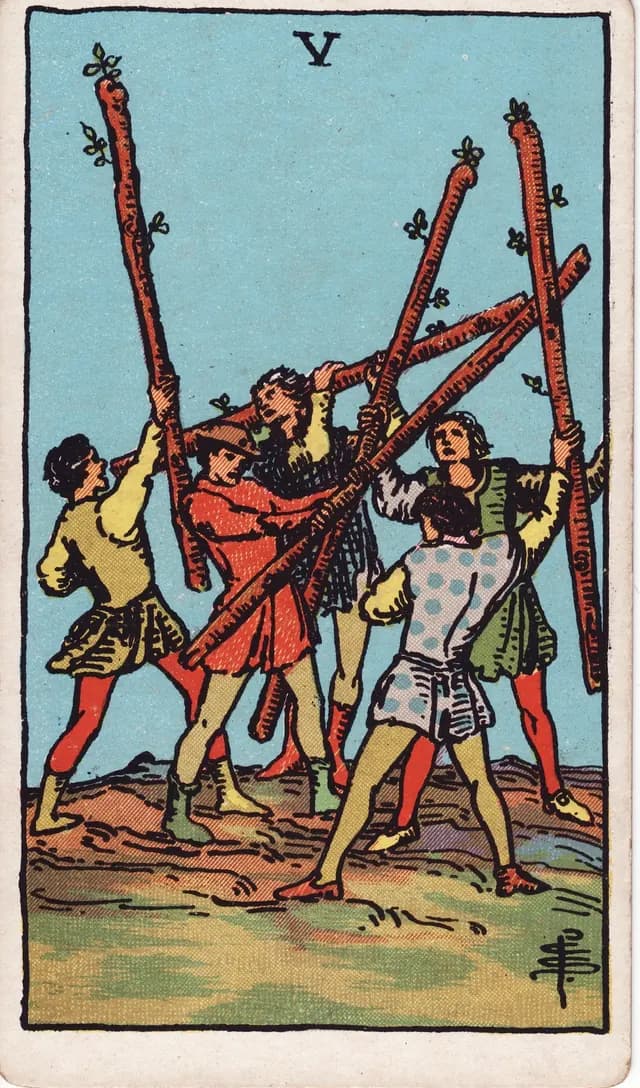
What Five of Wands as feelings means
The Five of Wands as feelings suggests emotional friction when strong wants struggle to share the same space. Interest can coexist with irritation, especially when your conversations keep becoming contests over whose preference matters. Look for interruptions, repeated comparisons, or difficulty accepting a different view during ordinary contact. These observable signs describe the exchange without proving attraction or explaining another person's private reasons for disagreeing.
Two people enjoy lively conversation until a small choice becomes a test of who gets their way. Notice whether the debate leaves you feeling engaged or unheard after the moment passes. Ask to discuss the actual preference without turning the disagreement into a score between partners. The Five's emotional heat becomes useful when it reveals needs that can be addressed without rewarding constant provocation.
Explore Five of Wands with your own draw
Your draw can reveal any card in the deck.
In love
In love, this card highlights feelings stirred by competing needs rather than assuming every argument conceals desire. Tell your partner which part of the exchange feels difficult and what would help you stay present. Listen for their stated need before defending the original position or trying to win approval. Mutual care shows in how disagreement is handled, including whether both people can pause and return without pressure.
At work
At work, this pattern can describe feeling energized by debate while also wanting your contribution to receive attention. Notice whether a challenge improves the idea or turns the meeting into a contest for status. Ask colleagues to compare proposals against the same criteria so enthusiasm has a useful direction. The emotional heat deserves a fair structure that lets different voices contribute without making disagreement personal.
Your next step
Name the feeling that follows a recent disagreement and connect it to the specific exchange. Separate your wish to be heard from a demand that the other person share every preference. Ask for one change in the conversation, such as letting each speaker finish their point. Watch whether the adjustment helps both people participate before deciding the friction is enjoyable or worth continuing.
How the Five of Wands Hints at Their Read on You
The Five of Wands suggests a person may find you stirring and a little hard to agree with. Like five figures crossing staffs, your talks might turn into friendly or tiring tests of will. How your energy reads to them may mix real interest with some honest friction. Calm talks about what each of you needs will reveal far more than the next clash.
- emotional friction
- competing needs
- heated exchange
- fair listening
The image behind this reading
You can see five figures gripping wooden staffs beneath the broad patch of blue sky.[1]
Read these meanings as modern interpretations of the imagery in your 1909 Rider-Waite-Smith deck.