
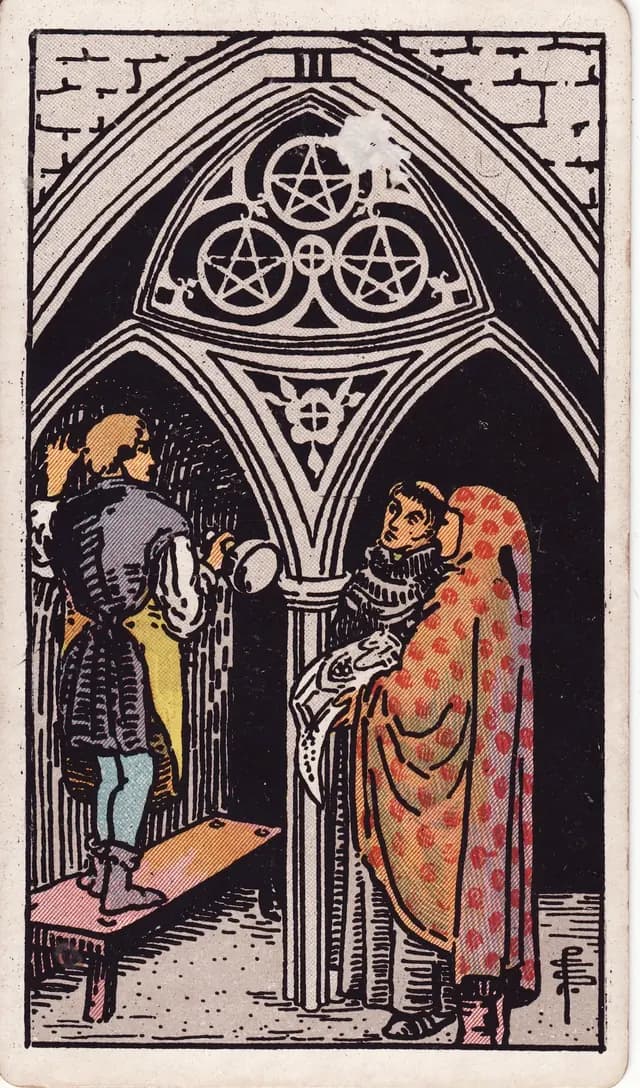
What Three of Pentacles yes or no means
Upright: Leaning yes, because your shared skills support the work.
Reversed: Leaning no, because your team has not found common ground.
Upright, the Three of Pentacles receives Leaning yes in Naksham's current yes or no classification. The answer supports your question where useful skills and a shared goal can come together. Check that each person understands their contribution before treating a promising team as ready. This favorable direction depends on actual cooperation, rather than assuming that putting skilled people together guarantees quality work.
Reversed, the Three receives Leaning no because the group has not established enough common ground. Conflicting standards or unclear roles can weaken your project even when everyone seems busy. Bring the expected result into a shared discussion before adding more effort to mismatched parts. An agreed method connects individual contributions, making cooperation the practical condition to assess in either orientation.
Explore Three of Pentacles with your own draw
Your draw can reveal any card in the deck.
In love
For a question about a shared relationship plan, upright Leaning yes supports working through details together. Confirm that both people want the same arrangement and can contribute in ways they accept. Reversed Leaning no points toward disagreements in your shared expectations before another commitment is made. Neither answer proves affection, so let mutual willingness guide the decision about building something as a couple.
At work
A collaborative project fits the upright answer when your team has relevant skills and accepted roles. Ask for a clear brief and a review point before approving the next stage of work. Reversed Leaning no calls attention to missing coordination that extra individual effort cannot resolve alone. Judge readiness through the actual team agreement, with this Three framing the question of whether its parts fit.
Your next step
Name the shared task at the center of your question and list everyone it depends on. Ask whether each person has accepted their role and understands the expected result clearly. Resolve one mismatch before interpreting enthusiasm as enough reason to proceed with the whole plan. The Three's practical condition is cooperation you can observe, including how the team handles questions before work begins.
- supported teamwork
- reversed mismatch
- shared readiness
- agreed method
The image behind this reading
Your eye can find three pentacles grouped above the people gathered inside the stone building.[1]
Read these meanings as modern interpretations of the imagery in your 1909 Rider-Waite-Smith deck.