
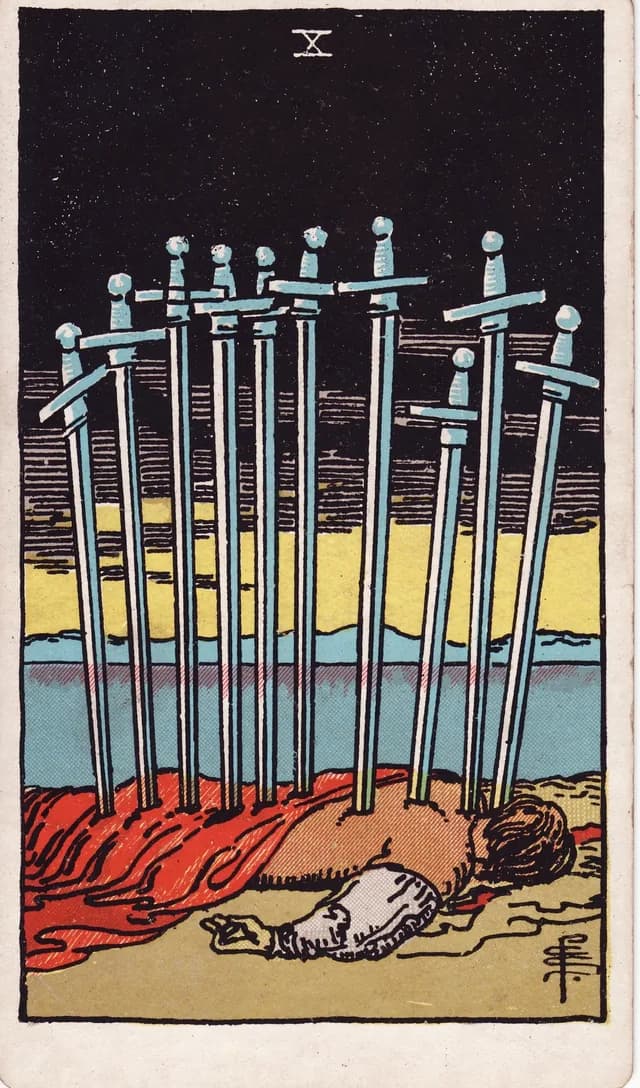
What Ten of Swords yes or no means
Upright: No, because your current path has reached its ending.
Reversed: Maybe, because your new start still needs time and support.
Upright, the Ten of Swords receives No because the current approach is read as having reached its ending. Apply that answer to your specific question rather than treating it as a verdict on every future possibility. The image’s finality invites an honest look at where continued effort no longer changes the actual conditions. A practical response begins by naming what has closed and what responsibility remains after that decision.
Reversed, the answer becomes Maybe because a first stage of rebuilding leaves the next arrangement unsettled. Ask whether your proposed step fits the support and circumstances actually available after the earlier ending. A new opening differs from restoring the old agreement exactly as it stood before. The classifications preserve that distinction, with no promise that recovery is complete or the next attempt must succeed.
Explore Ten of Swords with your own draw
Your draw can reveal any card in the deck.
In love
For a question about repeating an ended arrangement, upright No asks you to respect the closure already stated. A symbolic answer cannot decide another person’s feelings, but their clear boundary still deserves your attention. Reversed Maybe leaves room for a different step when both people freely agree and conditions have genuinely changed. Neither orientation promises reunion or requires treating continued pursuit as proof of how much the relationship mattered.
At work
An upright No can help you examine whether another round of effort repeats a project already closed. Confirm the actual decision before allocating more work to an approach the team no longer supports. Reversed Maybe favors reviewing a modest new option with different conditions and an honest account of available resources. The Ten keeps the decision tied to what remains workable, rather than pressure to redeem every earlier investment.
Your next step
State the proposed action and ask whether it respects what has already ended in your situation. If it depends on undoing a clear refusal, return to the real boundary before making another attempt. For a new step, list the conditions that distinguish it from repeating the same exhausted approach. The Ten becomes a practical decision prompt when closure and rebuilding are assessed as separate questions.
- upright no
- reversed maybe
- closed chapter
- new conditions
The image behind this reading
You can see still water behind the fallen figure beneath a narrow band of yellow sky.[1]
Read these meanings as modern interpretations of the imagery in your 1909 Rider-Waite-Smith deck.