
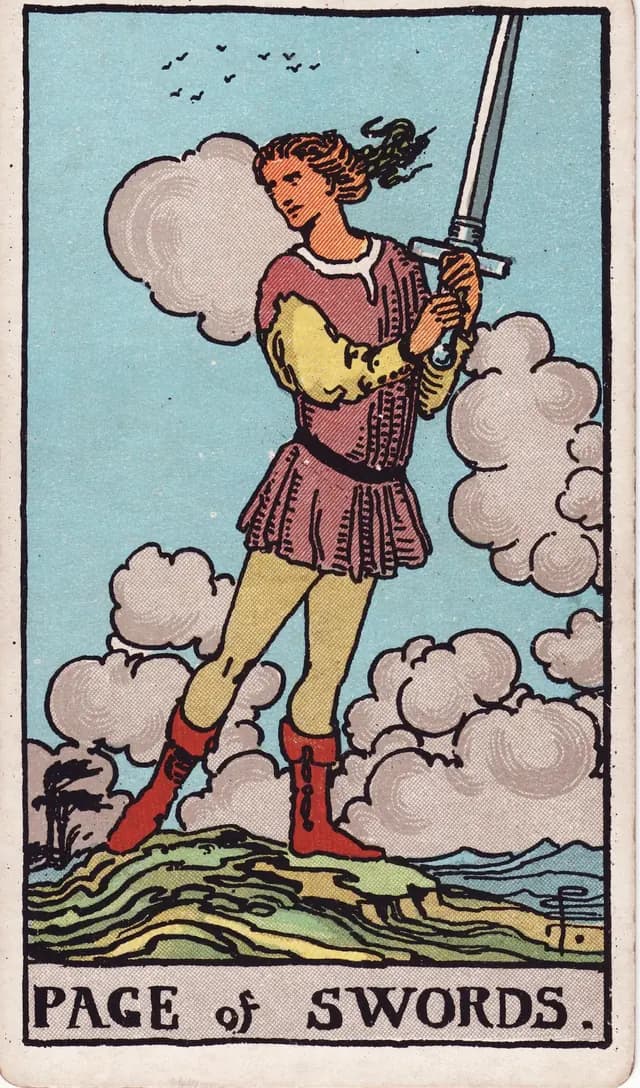
What Page of Swords yes or no means
Upright: Maybe, because your curiosity needs firmer facts before a choice.
Reversed: Leaning no, because your information is shaky and words need care.
Upright, the Page of Swords receives Maybe because curiosity has not yet supplied enough reliable information. A bright question can open a useful inquiry without deciding which answer you will eventually choose. Treat the classification as a prompt to examine what remains unknown about the proposed action. The watchful figure fits a learning stage, where careful observation needs a direct factual check.
Reversed, the answer becomes Leaning no as rushed words or shaky news weaken the available account. Ask whether your decision relies on something repeated by others rather than confirmed at its source. The orientations differ through how curiosity is used, with uncertainty becoming less workable when speech runs ahead. A practical condition is an accurate answer to the question that actually changes your decision.
Explore Page of Swords with your own draw
Your draw can reveal any card in the deck.
In love
For a question about approaching someone, upright Maybe asks what interest has actually been expressed. A lively exchange can justify a respectful question without establishing that your preferred answer will follow. Reversed Leaning no gives particular reason to check gossip or an ambiguous message before acting. Keep any invitation clear and easy to decline, with the person’s response carrying more weight than the reading.
At work
A training or research opportunity fits upright Maybe when its details still need a closer look. Ask what you will learn, what work is expected, and who can answer practical questions. Reversed Leaning no points toward making a choice from incomplete news or a poorly explained brief. The Page favors gathering information that changes the decision, rather than gathering material to justify an existing preference.
Your next step
Identify the claim that would make your proposed step sensible if it were confirmed. Find a direct source and ask for the detail that supports or challenges that claim. Record what remains unknown without filling the gap with confidence borrowed from another person’s excitement. The Page turns an open answer into purposeful inquiry, giving your eventual decision a clearer basis.
- curious maybe
- checked news
- reversed caution
- informed choice
The image behind this reading
You see dark birds above the Page and bent trees near the lower left corner.[1]
Read these meanings as modern interpretations of the imagery in your 1909 Rider-Waite-Smith deck.