
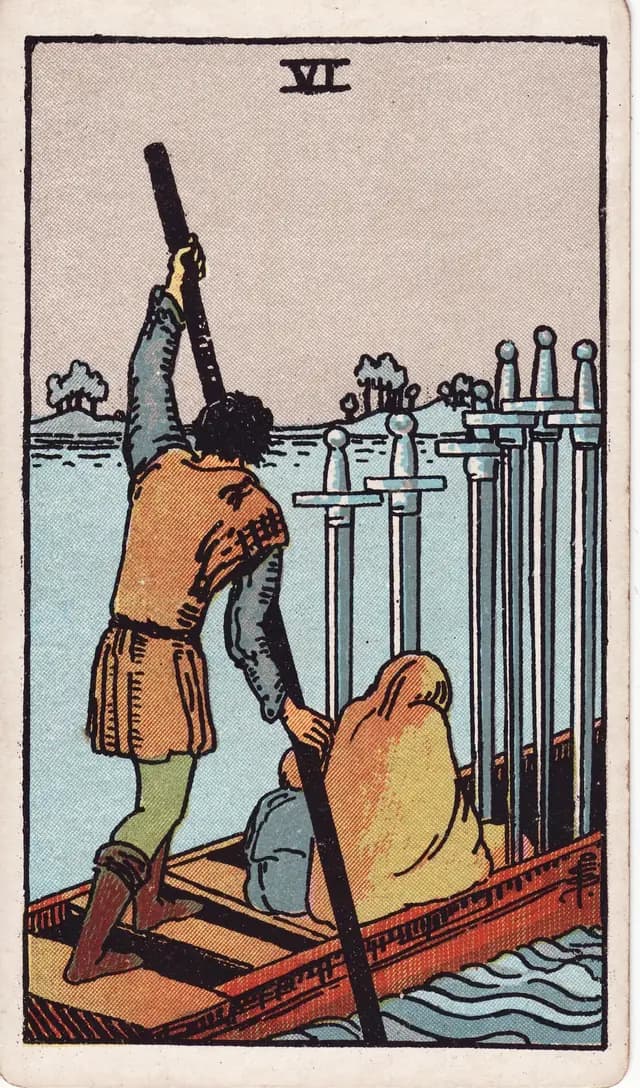
What Six of Swords yes or no means
Upright: Maybe, because your crossing has begun but remains unfinished.
Reversed: Leaning no, because your move remains held by unfinished concerns.
Upright, the Six of Swords receives Maybe because the passage is underway but the arrival remains unsettled. Apply that answer to your proposed next step, including the practical conditions needed for a workable change. The boat offers direction without showing every detail of what awaits on the distant shore. A promising move still needs an agreed destination, available support, and responsibilities that someone will actually carry.
Reversed, the answer becomes Leaning no because unfinished concerns keep the passage from moving forward. Ask which part of your plan remains blocked and whether the obstacle has a concrete solution. Emotional reluctance and missing arrangements can appear together, so neither should be dismissed without examination. The answers differ through the state of the crossing, rather than a rule that reversals always invert outcomes.
Explore Six of Swords with your own draw
Your draw can reveal any card in the deck.
In love
For a question about moving beyond conflict, upright Maybe leaves room for a shared change in behavior. Identify the agreement you need before treating a quiet weekend as proof that the issue is resolved. Reversed Leaning no asks whether old arguments or unclear boundaries keep the proposed change from taking hold. Both answers depend on actual participation, with no promise that another person will choose the same direction.
At work
A work transition fits upright Maybe when the next role is promising but its arrangements remain unfinished. Confirm the responsibility, timing, and support that your move needs before treating discussion as a settled agreement. Reversed Leaning no points toward the unresolved condition keeping the handover or departure stalled. The practical decision should follow those facts instead of using the card to approve an unsupported leap.
Your next step
List the conditions that would make your next step a workable passage rather than another uncertain promise. Mark which conditions are confirmed and which still depend on a conversation that has not happened. Choose one missing agreement to clarify before making a commitment that assumes the whole move is settled. This turns the Six into a decision prompt with a visible next step and an honest limit.
- upright maybe
- delayed move
- reversed hesitation
- practical passage
The image behind this reading
You see rippled water beside the boat and a smoother stretch beyond the seated passengers.[1]
Read these meanings as modern interpretations of the imagery in your 1909 Rider-Waite-Smith deck.