
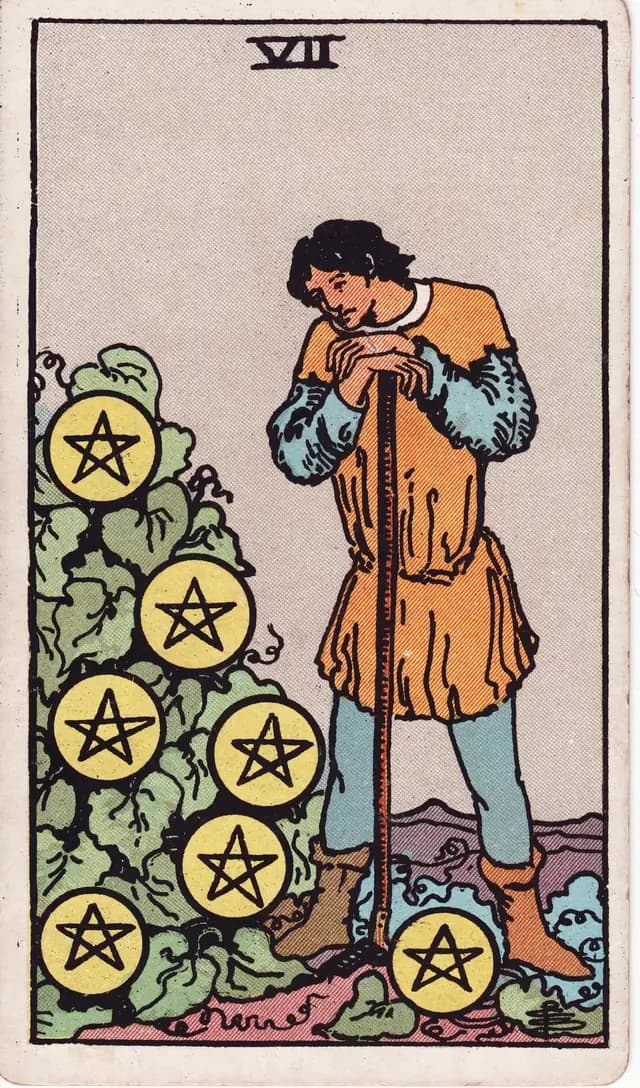
What Seven of Pentacles yes or no means
Upright: Maybe, because your progress still needs time and review.
Reversed: Leaning no, because your effort is not paying off yet.
Upright, the Seven of Pentacles receives Maybe in Naksham's current classification because progress remains under review. The gardener has something growing, but your question cannot be settled by effort already spent. Check which stage has been reached and whether the next stage has a realistic timetable. This answer leaves room for patient development without presenting an unfinished process as a certain positive result.
Reversed, the classification becomes Leaning no because continued effort is not paying off at present. The practical question is whether your method and timing still fit the result being sought. Review the obstacle before adding more hours to a process that repeatedly returns the same disappointment. These orientations distinguish developing progress from stalled returns, rather than making opposite predictions about a fixed future.
Explore Seven of Pentacles with your own draw
Your draw can reveal any card in the deck.
In love
For relationship questions, the upright Maybe asks whether shared care is producing mutual growth over time. Discuss one concrete change you both hoped to see before treating patience as the answer. Reversed Leaning no calls attention to an effort pattern that currently leaves the bond unmoved. Neither label supplies consent or another person's feelings, so their direct response remains part of any practical decision.
At work
A project review fits this card better than asking whether all your hard work will succeed. Upright Maybe supports checking completed stages before agreeing that the next phase is ready. Reversed Leaning no asks whether the current approach deserves more effort without meaningful changes. Use the team's actual results and agreed standards to decide what the unfinished harvest requires next.
Your next step
Frame your question around continuing one defined approach for a clear period of time. Write the progress that would make that choice worthwhile and the point for reviewing it. For upright Maybe, allow realistic development while keeping that review attached to visible evidence. For the reversed answer, identify what must change before another cycle of the same effort makes sense.
- upright maybe
- reversed caution
- developing results
- review condition
The image behind this reading
You see six coins grouped in the plant above the single coin near the ground.[1]
Read these meanings as modern interpretations of the imagery in your 1909 Rider-Waite-Smith deck.