
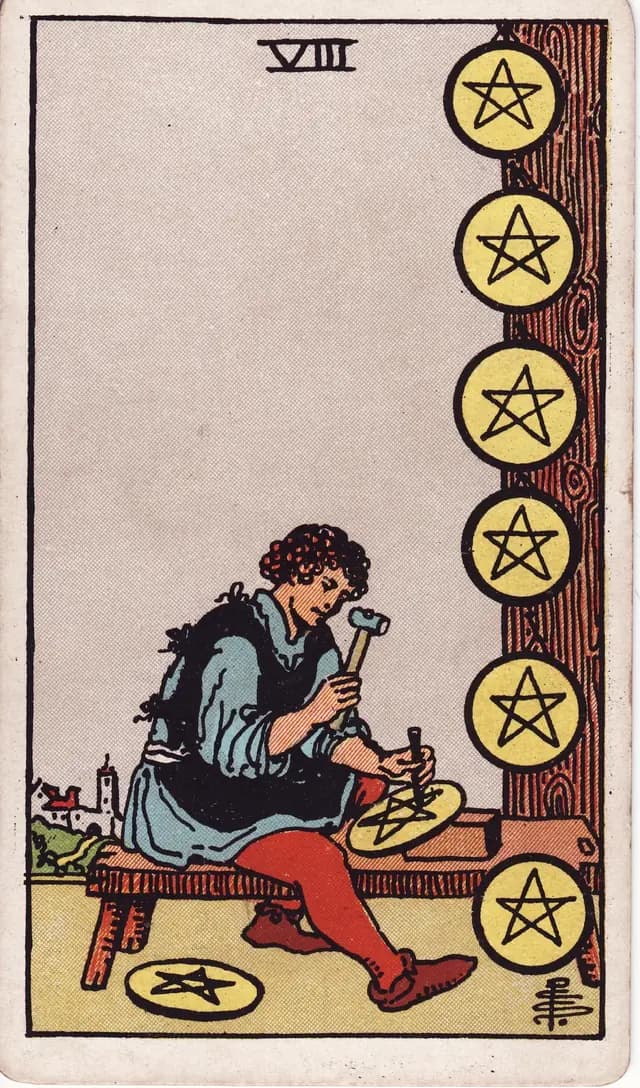
What Eight of Pentacles yes or no means
Upright: Leaning yes, because your steady practice builds the needed skill.
Reversed: Leaning no, because your work needs more care and practice.
Upright, the Eight of Pentacles receives Leaning yes in Naksham's current map of card answers. The favorable reading rests on your willingness to practice carefully and learn from each completed attempt. Check that the task has a clear standard and that useful feedback is available. This supports an effort-based decision without turning hard work into a guarantee of reaching every goal.
Reversed, the answer is Leaning no because the work still needs more care or preparation. A rushed result or repeated error gives you a practical reason to pause before proceeding. Identify the missing skill and choose an exercise that addresses it directly, with a clear review afterward. Both orientations focus on practice quality, with completed work providing a clearer readiness check than hours alone.
Explore Eight of Pentacles with your own draw
Your draw can reveal any card in the deck.
In love
For a question about improving a bond, upright Leaning yes supports thoughtful effort from both people. Choose one shared habit you each want to practice and make room for honest feedback. Reversed Leaning no asks whether the current routine gives the relationship real attention or only mechanical effort. Neither answer proves another person's willingness, so agree the change before treating improvement as a shared project.
At work
A question about learning a skill fits the Eight when practice time and useful guidance exist. Upright Leaning yes encourages your next measured attempt within a process that can show improvement. Reversed Leaning no points toward the standard that rushed or unfocused work has not yet met. Inspect a finished sample and relevant feedback before deciding whether the task is ready for wider use.
Your next step
Write your question around a task whose quality can be checked after a completed attempt. Define the standard, arrange focused practice, and identify someone able to give useful feedback. Let the upright answer support that process while keeping its practical requirements visible to you. If reversed, address the weak detail before proceeding and assess the actual work after that correction.
- qualified yes
- practice condition
- reversed preparation
- quality check
The image behind this reading
You see the worker seated on a wooden bench with a separate coin near the ground.[1]
Read these meanings as modern interpretations of the imagery in your 1909 Rider-Waite-Smith deck.