
What Six of Pentacles yes or no means
Upright: Leaning yes, because your fair exchange supports the next step.
Reversed: Maybe, because your exchange still needs fair and clear terms.
Upright, the Six of Pentacles receives Leaning yes in Naksham's current yes or no classification. Its favorable direction fits your question where help can be offered and received on fair terms. Check that the contribution is available and that everyone understands what the exchange includes. A helpful exchange supports the next step without guaranteeing how every later part of the situation will unfold.
Reversed, the Six receives Maybe because giving and receiving still need clearer or more balanced terms. An offer can remain useful while its conditions make your decision harder to assess. Ask who sets the rules and whether both people can decline or suggest changes. A freely accepted agreement separates useful support from unsettled fairness, providing a practical condition to assess before proceeding.
Explore Six of Pentacles with your own draw
Your draw can reveal any card in the deck.
In love
For a relationship question, upright Leaning yes supports care that respects what both people can give. Talk about your actual needs before accepting a plan that looks generous from only one perspective. Reversed Maybe asks whether uneven effort or unspoken expectations still need to be addressed. Shared willingness remains necessary before practical help takes a place within a larger agreement about the relationship.
At work
A work proposal fits upright Leaning yes when the offered support has clear scope and practical value. Confirm what your team will receive and what contribution, acknowledgment, or access is expected in return. Reversed Maybe calls for reviewing an uneven arrangement before making the project depend on it. The actual terms give the decision firmer ground than a general promise that support will be available somehow.
Your next step
Write the proposed exchange in two short lists, showing what each person gives and receives. Include time, access, and decision rights alongside the obvious item or service being offered. Ask about any expectation that you cannot place clearly in either part of the agreement. Shared understanding keeps the choice informed, without either person discovering a new obligation after the exchange has begun.
- fair support
- reversed uncertainty
- clear exchange
- mutual agreement
The image behind this reading
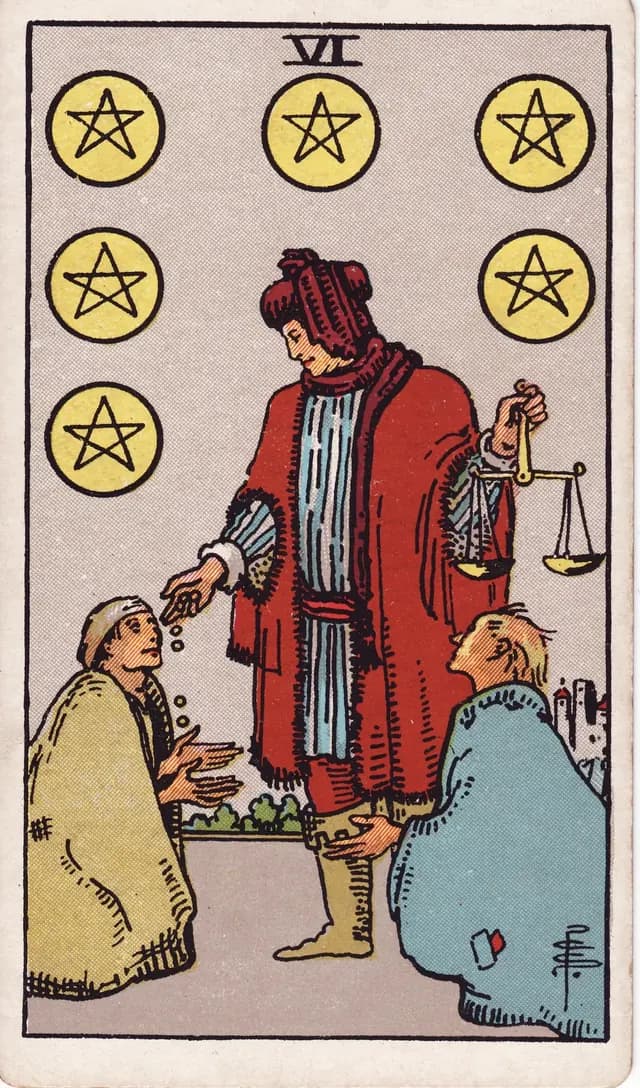
Your eye can find six gold pentacles arranged above the giver and the two kneeling figures.[1]
Read these meanings as modern interpretations of the imagery in your 1909 Rider-Waite-Smith deck.