
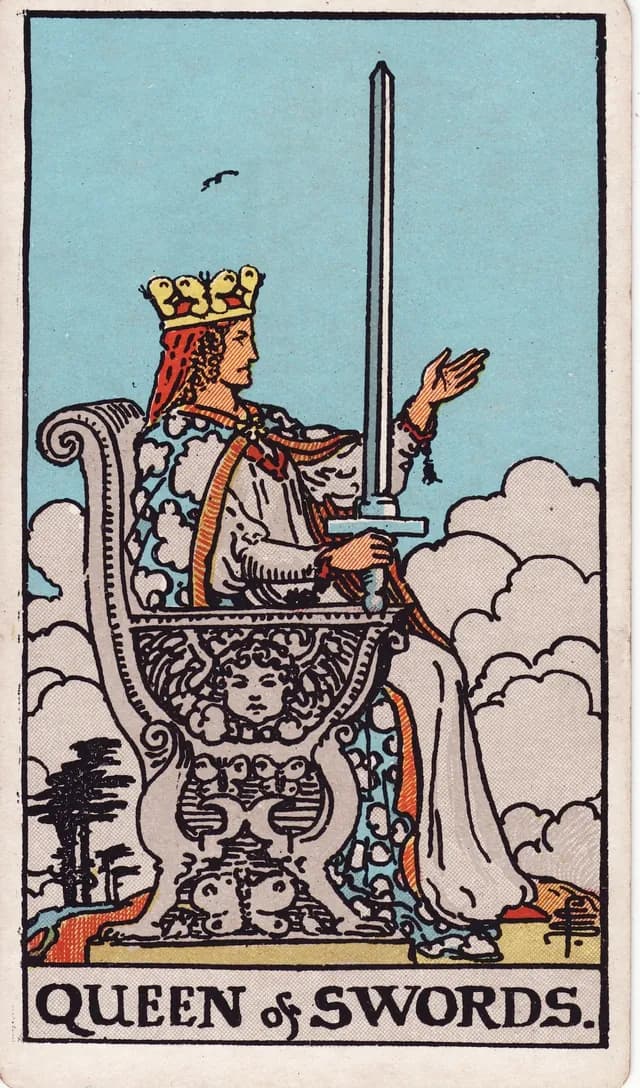
What Queen of Swords reversed means
The Queen of Swords reversed suggests your clear thinking has become harder to share kindly. Old disappointment can make every new conversation feel like a test someone must pass. A quick correction or clipped reply then hides the care underneath your firm position. Keep the standard that matters, while choosing words that leave room for an honest answer.
Consider a friend who changes plans after you have already made time for them. Naming the inconvenience is fair, but listing every previous mistake turns the talk into punishment. The reversed queen asks you to separate this broken agreement from an entire personal history. Request a clear update next time, then decide whether their actual response meets your needs.
Explore Queen of Swords with your own draw
Your draw can reveal any card in the deck.
In love
In love, this reversal draws attention to distance built through repeated criticism or guarded replies. A partner cannot understand your hurt when every attempt to explain becomes another sharp correction. Name the specific moment that hurt, and ask for one change they can understand. Keeping a boundary works better when its terms are clear and its language remains humane.
At work
At work, the reversed queen highlights feedback whose sharp delivery hides an otherwise useful point. Read your draft message and separate the missed requirement from judgments about the person's ability. Describe the needed revision, give a clear example, and leave time for questions afterward. This restores the card's honest standards without turning a correction into a public contest.
Your next step
Before your next difficult conversation, write the central fact without adding a motive or insult. Place the boundary beside it, using an action that rests within your own control. Practice saying both aloud at a pace that allows the other person to respond. The reversed queen's growth comes through warmer delivery, while the important limit stays clearly named.
- guarded judgment
- sharp delivery
- old hurt
- warmer boundaries
The image behind this reading
You see the queen's open hand reaching outward beside the sword held vertically above her throne.[1]
Read these meanings as modern interpretations of the imagery in your 1909 Rider-Waite-Smith deck.