
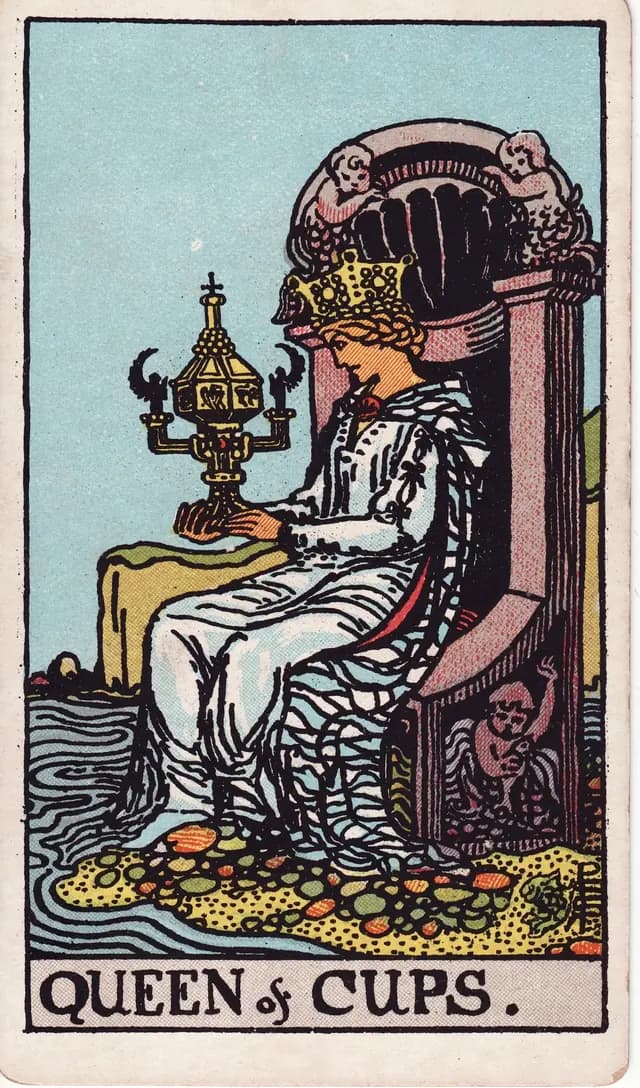
What Queen of Cups yes or no means
Upright: Leaning yes, because thoughtful care gives your choice a kind base.
Reversed: Maybe, because your care needs clearer limits before more giving.
The Queen of Cups upright receives Leaning yes in Naksham's current map, favoring thoughtful care and emotional attention. Apply the answer to a choice whose kindness responds to a need you have actually heard expressed. Check that the support is welcome and that its demands fit what you can realistically offer. The carefully held cup frames a considered response whose practical limits keep care useful beyond the first exchange.
Reversed, the classification is Maybe because overextended care can make the next commitment difficult to assess clearly. Ask whether your proposed action meets a real request or tries to manage someone else's entire emotional experience. A useful condition is defining the amount and kind of support available before saying yes. These orientations compare responsive care with blurred limits without making unlimited giving the measure of genuine affection.
Explore Queen of Cups with your own draw
Your draw can reveal any card in the deck.
In love
For love, upright Leaning yes supports a thoughtful exchange that makes room for your actual feelings and limits. Ask whether the proposed conversation or gesture feels welcome to both people before assuming kindness settles every question. Reversed Maybe highlights giving that leaves one partner responsible for maintaining the other's mood throughout the relationship. Name that imbalance before another promise expands the same pattern beyond what either person can sustain comfortably.
At work
At work, upright Leaning yes fits a response that considers people while keeping your professional responsibilities clear. Ask for specific feedback and use it to shape a task whose scope the team understands. Reversed Maybe asks whether another request for help would leave your own agreed work without enough attention. Check ownership and available time before treating every emotional concern as something you personally need to resolve.
Your next step
Name the need behind the question and ask whether the person involved actually wants the support being considered. Write what you can give without postponing an important commitment or leaving your own limits unspoken. Use upright Leaning yes to explore a caring choice whose practical demands are clear and welcome. With reversed Maybe, reduce or define the offer before deciding whether another act of giving would really help.
- upright leaning yes
- reversed maybe
- welcome support
- sustainable care
The image behind this reading
Notice the narrow shoreline beneath the throne as you follow its curved edge against the patterned water.[1]
Read these meanings as modern interpretations of the imagery in your 1909 Rider-Waite-Smith deck.