
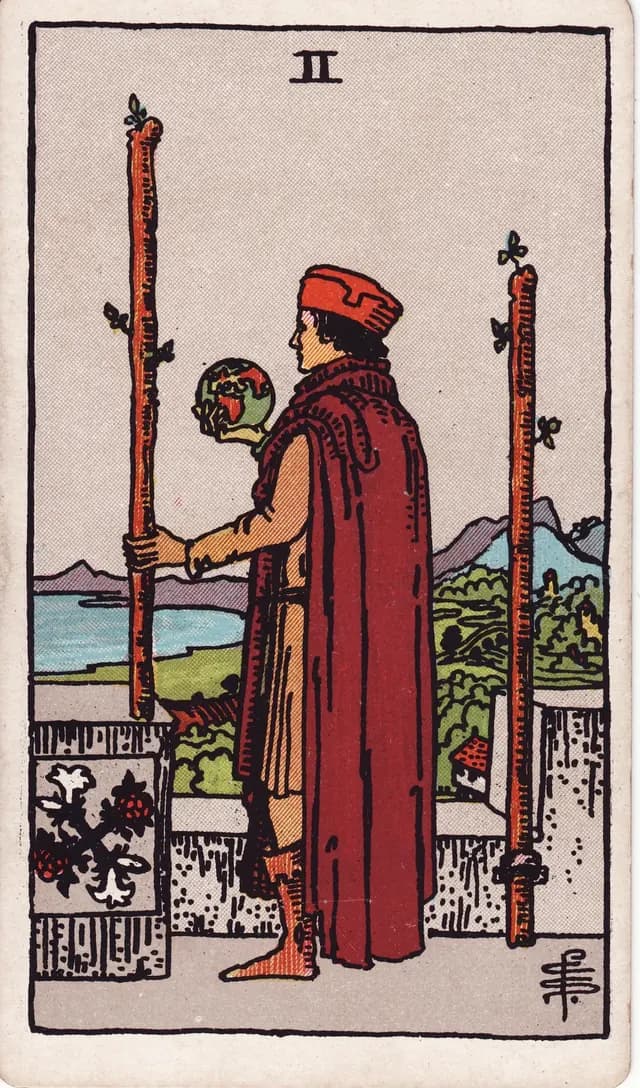
What Two of Wands yes or no means
Upright: Maybe, because your next direction still needs a clear choice.
Reversed: Leaning no, because your direction needs a firmer choice first.
The Two of Wands upright receives Maybe in Naksham's current map, keeping the decision open during planning. A wider view offers possibilities, but your chosen route still needs a clear and practical commitment. Use the reading to compare actual options rather than expecting an answer to choose on your behalf. The condition for moving forward is knowing which direction fits and what first action would begin it.
Reversed, the live label is Leaning no because hesitation or a thin plan makes proceeding premature. Check whether your uncertainty concerns missing information or the difficulty of ruling out an appealing alternative. A focused question can resolve the first issue, while a limited trial can help with the second. Both orientations concern direction, but the reversal gives stalled preparation a stronger reason to pause before committing.
Explore Two of Wands with your own draw
Your draw can reveal any card in the deck.
In love
For love, upright Maybe invites a discussion about the next chapter before either person assumes it is chosen. Ask whether your future preferences fit and which shared step both people actually want to consider. Reversed Leaning no draws attention to hesitation that needs a clearer answer before plans become commitments. Let the conversation reveal the available relationship rather than reading future interest as a settled promise of agreement.
At work
At work, upright Maybe suits comparing routes for a project, partnership, or change of role. Define the criteria that matter to your decision and check the facts that could alter the choice. Reversed Leaning no asks whether the current plan has enough direction to justify a larger commitment. Close that gap through a focused review instead of treating delay itself as careful preparation for action.
Your next step
Write your question around two real options and the next decision needed between them now. Choose a small number of criteria that reflect your actual goal instead of every possible advantage. Use upright Maybe to compare those criteria, then name the route that best fits the evidence. For the reversal, strengthen the missing part of the plan before agreeing to leave the familiar arrangement behind.
- upright maybe
- reversed hesitation
- direction choice
- practical planning
The image behind this reading
Look at the stone wall under the figure's hand as you trace the view toward the sea.[1]
Read these meanings as modern interpretations of the imagery in your 1909 Rider-Waite-Smith deck.