
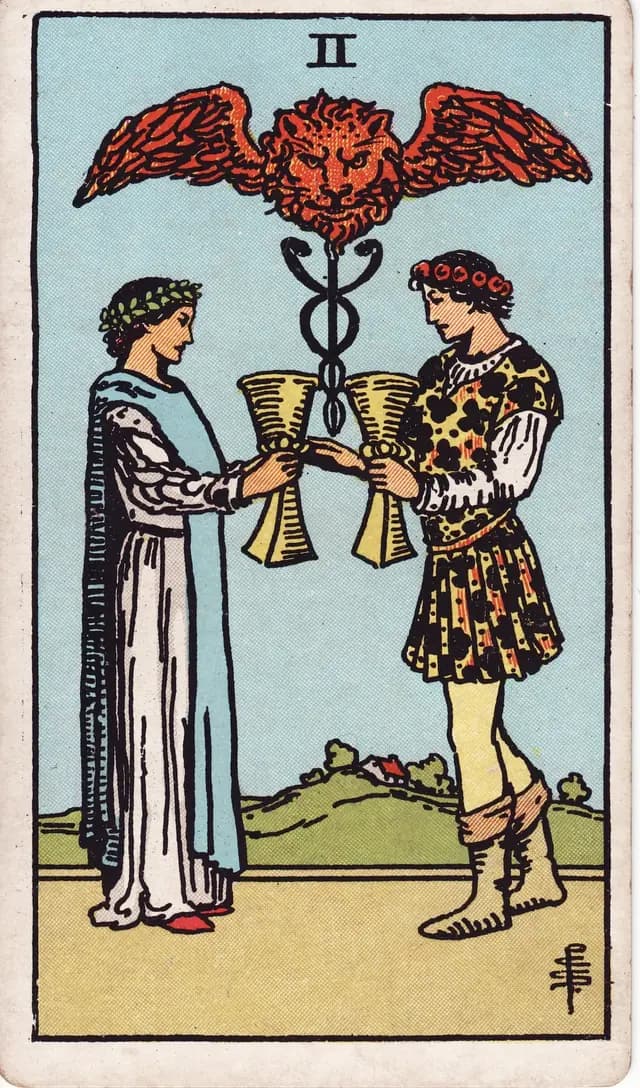
What Two of Cups yes or no means
Upright: Yes, because your shared choice rests on care returned.
Reversed: Leaning no, because your bond needs a fairer exchange first.
The Two of Cups upright receives Yes in Naksham's current map, favoring a choice grounded in mutual participation. Apply the answer to an agreement where your needs and the other person's needs can both be named. A practical condition is having clear consent to the same arrangement rather than only a warm connection. The paired cups frame equal exchange, while the participants must make an agreement they can actually carry out.
Reversed, the independent classification is Leaning no because the live map assigns no with medium confidence. Ask whether your proposed next step would deepen an imbalance that neither person has yet agreed to address. Clearer terms can improve the actual choice without turning the reversed answer into a guaranteed future Yes. Both orientations concern partnership, with reversal asking whether fairness can support the additional commitment now being considered.
Explore Two of Cups with your own draw
Your draw can reveal any card in the deck.
In love
For love, upright Yes fits a next step whose meaning and pace both people have willingly discussed. Ask whether your hopes match the agreement actually present instead of letting affection stand in for that conversation. Reversed Leaning no highlights a bond where uneven effort or unmet needs make further commitment harder to assess. Let direct answers and consistent care guide the decision, since a favorable card cannot create another person's willingness.
At work
At work, upright Yes supports considering a partnership with clear roles and a goal both sides genuinely share. Compare what you are expected to contribute with the authority, support, and credit included in the agreement. Reversed Leaning no asks whether one person carries responsibility while another controls the decisions or receives most recognition. Resolve that mismatch before relying on goodwill to sustain a project whose terms still favor only one side.
Your next step
Write the proposed agreement in one sentence and ask both people to describe what accepting it would mean. Compare the answers before committing your time, especially where a friendly discussion has left important expectations unstated. Consider upright Yes when the exchange is clear and both people can freely choose to participate. With reversed Leaning no, identify one uneven term that needs attention before adding more responsibility to the partnership.
- upright yes
- reversed leaning no
- mutual consent
- balanced agreement
The image behind this reading
Notice the red winged lion above the cups as you trace its wings across the sky.[1]
Read these meanings as modern interpretations of the imagery in your 1909 Rider-Waite-Smith deck.