
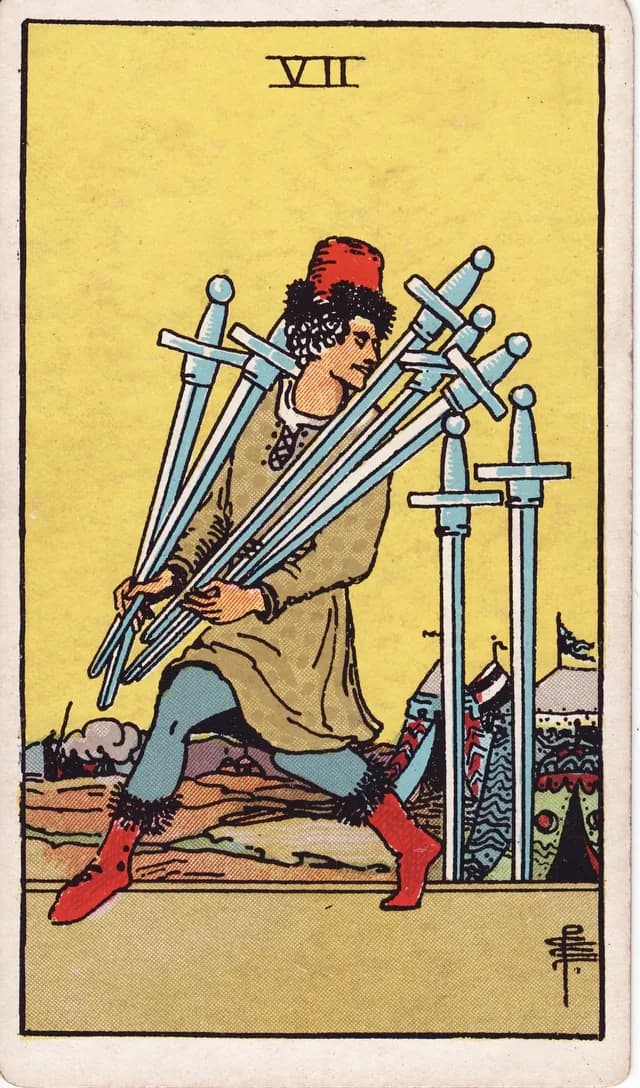
What Seven of Swords as feelings means
The Seven of Swords as feelings suggests you are keeping part of an emotional response unspoken. That can involve discomfort about openness, a wish for privacy, or reluctance to answer a direct question. The growth area concerns what remains hidden from a conversation that needs mutual understanding to continue. Treat the reading as a possible pattern, without using a guarded response as proof of dishonesty.
Someone may answer the easier part of your question while leaving the central feeling unnamed. Notice the gap in the conversation rather than deciding which private emotion must occupy it. A backward glance in the artwork offers an image for attention divided between departure and what remains behind. The useful next step is a clear question about what the person is willing to discuss.
Explore Seven of Swords with your own draw
Your draw can reveal any card in the deck.
In love
Private feelings become a shared concern when an incomplete answer leaves you relying on an unclear agreement. Ask what the person can honestly offer now, even if they cannot explain every emotion behind it. A boundary around personal history differs from implying commitment that has never been freely chosen. The Seven asks for enough openness to understand the relationship, without granting access to every private thought.
At work
A colleague can avoid naming dissatisfaction while quietly reducing their involvement in optional team discussions. Check the actual work agreement before assuming the change expresses resentment toward you or the group. A direct question about responsibilities can clarify the situation without demanding a personal emotional disclosure. The Seven highlights what remains outside the account, with professional facts taking priority over guesses about mood.
Your next step
Name the feeling you find hardest to state and what you expect would happen if it were heard. Separate the need for privacy from the wish to let someone rely on a misleading impression. Choose a truthful boundary when disclosure is unnecessary, or a clear answer when an agreement depends on it. The Seven becomes practical when your words accurately describe what another person can reasonably expect.
How the Seven of Swords Hints at a Private Opinion of You
The Seven of Swords suggests someone may be keeping part of their opinion about you out of sight. The figure glancing back hints at a private impression they have not chosen to share. Holding back can come from shyness or caution as easily as from anything unkind. A clear and friendly question, asked once, gives them room to show you more.
- private feelings
- guarded disclosure
- uneasy trust
- indirect expression
The image behind this reading
You notice the backward glance of the figure carrying five swords away from the colorful tents.[1]
Read these meanings as modern interpretations of the imagery in your 1909 Rider-Waite-Smith deck.