
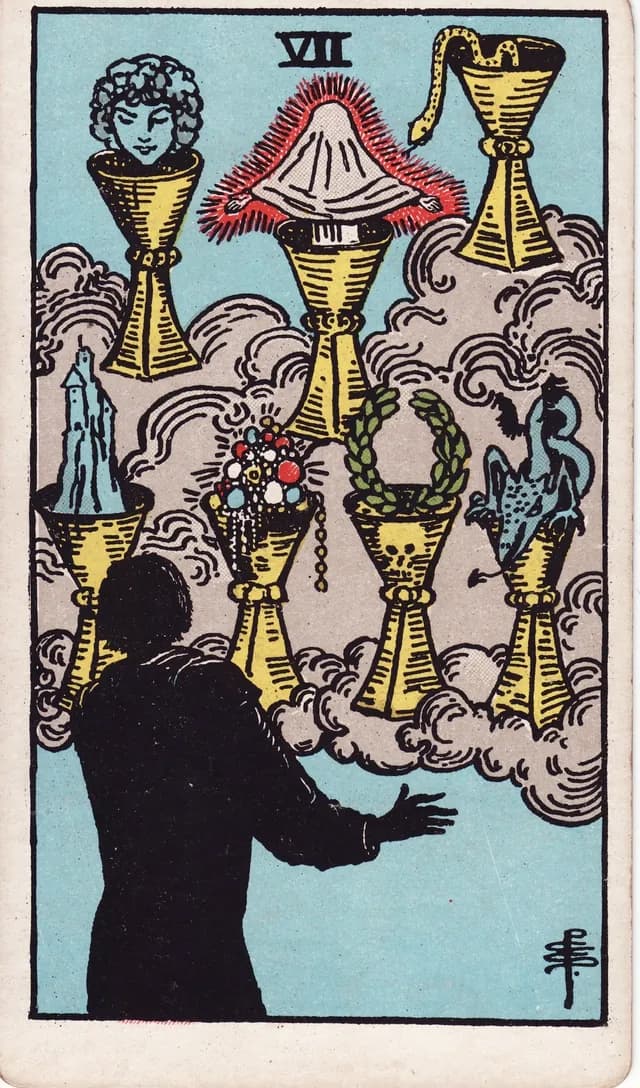
What Seven of Cups yes or no means
Upright: Leaning no, because your options still need a closer look.
Reversed: Maybe, because your clearer choice still needs a real check.
The Seven of Cups upright receives Leaning no in Naksham's current map because attractive possibilities lack clear grounding. Apply the answer to a proposal whose imagined reward is more detailed than its actual terms. Ask which part you have verified and which part depends on filling missing information with hope. The floating cups frame uncertainty, making a closer examination more useful than choosing the most appealing picture immediately.
Reversed, the answer remains Maybe while the confusion begins clearing and a more realistic preference emerges. Check whether your chosen option survives a practical question about time, availability, or the work involved. A useful condition is obtaining one concrete piece of evidence before making a larger commitment. A clearer starting point makes examination easier without proving the remaining possibility will produce a dependable result.
Explore Seven of Cups with your own draw
Your draw can reveal any card in the deck.
In love
For love, upright Leaning no asks whether the proposed step depends on a relationship imagined more than discussed. Ask what your actual contact supports before building plans around a future the other person has not accepted. Reversed Maybe fits a clearer conversation that still leaves questions about shared wishes or timing unresolved. Neither answer supplies consent, so the decision depends on terms both people state and freely choose.
At work
At work, upright Leaning no highlights an attractive proposal whose basic details have not received enough examination. Ask for a sample, a defined task, or a realistic schedule before promising your contribution. Reversed Maybe gives room to assess a narrowed option after its larger claims have been checked. Evidence about the actual work matters more than the confidence or excitement surrounding its initial description.
Your next step
Turn the question into a choice about one named option with terms that can be checked. Identify the most important unknown and ask someone able to provide information about that specific point. Use upright Leaning no to pause when the answer still relies mainly on a desirable imagined outcome. With reversed Maybe, test the clearer option modestly and compare what happens with the reason you selected it.
- upright leaning no
- reversed maybe
- unchecked promise
- clearer option
The image behind this reading
Notice the string of jewels spilling from one cup as you look beneath the central veiled figure.[1]
Read these meanings as modern interpretations of the imagery in your 1909 Rider-Waite-Smith deck.