
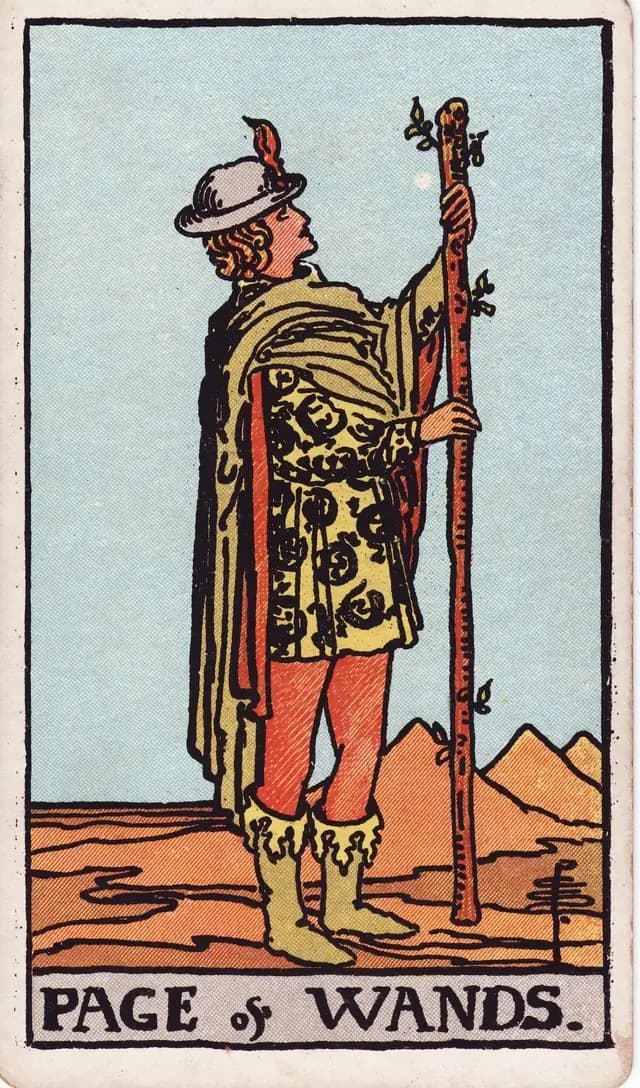
What Page of Wands yes or no means
Upright: Maybe, because your new interest needs a real trial.
Reversed: Leaning no, because your scattered spark needs a clear focus.
The Page of Wands upright receives Maybe in the current map because the beginning remains exploratory. Enthusiasm points toward something worth learning about, while the next outcome is still too unsettled to classify positively. Ask whether your question concerns a modest trial or a commitment that requires much stronger evidence. The practical condition is a clear learning step with limits that fit the experience you currently have.
Reversed, the current answer is Leaning no because scattered attention leaves the spark without useful direction. Identify which unfinished beginning deserves your focus before taking responsibility for another unfamiliar undertaking. A completed practice session can show whether the problem is missing skill, divided attention, or fading interest. The upright label leaves exploration open, while the reversal asks for firmer focus before adding another commitment.
Explore Page of Wands with your own draw
Your draw can reveal any card in the deck.
In love
For love, upright Maybe suits a connection whose playful interest has not become a clear mutual agreement. Ask what the next invitation means instead of assuming your enjoyment already answers every question about commitment. Reversed Leaning no directs attention toward excitement that changes before reliable contact can develop. Judge participation through actual exchanges, since neither label establishes another person's feelings or promises their next message.
At work
At work, upright Maybe invites a limited learning exercise before deciding whether a new approach fits the task. Check what your team needs to discover and how the first example will be reviewed. Reversed Leaning no asks whether another idea would distract from the unfinished work already needing attention. Choose from available evidence, giving curiosity a practical role without making enthusiasm responsible for proving the proposal.
Your next step
Frame your question around trying one unfamiliar activity within a clear and manageable limit. Name what the attempt should teach before deciding how much time to spend exploring it. With upright Maybe, gather experience and review whether the interest survives contact with ordinary beginner difficulties. With reversed Leaning no, finish or deliberately close an earlier trial before exploring another attractive but undefined possibility.
- upright maybe
- reversed leaning no
- early exploration
- focused trial
The image behind this reading
Look at the three pointed hills behind the figure as you follow the staff toward the sand.[1]
Read these meanings as modern interpretations of the imagery in your 1909 Rider-Waite-Smith deck.