
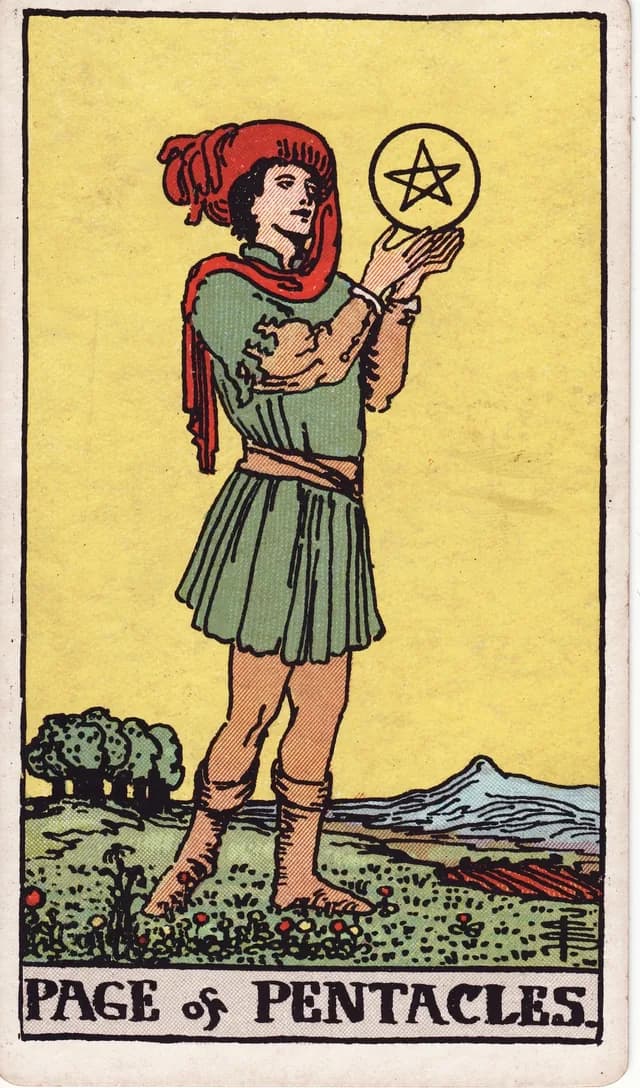
What Page of Pentacles yes or no means
Upright: Maybe, because your promising start still needs practical learning.
Reversed: Leaning no, because your promising plan still lacks steady follow-through.
Upright, the Page of Pentacles receives Maybe in Naksham's current classification of card answers. Interest and a grounded opportunity give your question promise, but learning and preparation remain unfinished. Check what the first attempt can actually demonstrate before deciding that the larger task is ready. The Page's open answer makes room for a useful beginning whose readiness can be assessed through completed groundwork.
Reversed, the answer becomes Leaning no because delay or weak follow-through keeps the plan from becoming workable. Scattered attention can leave you with many appealing ideas and no completed task to examine. Choose one practical step and assess its result before adding further commitments to the same plan. These orientations distinguish an engaged beginner from a stalled beginning while preserving the live map's separate answer labels.
Explore Page of Pentacles with your own draw
Your draw can reveal any card in the deck.
In love
For a question about starting contact, upright Maybe supports checking whether a simple invitation is mutually welcome. Keep your proposal small enough for the other person to answer clearly without pressure about the future. Reversed Leaning no asks whether repeated delays or unfinished arrangements have already weakened the practical basis for meeting. Neither label reveals private affection, so the actual response remains necessary before deciding on the next step.
At work
A question about beginning training fits the upright Page when a real learning opportunity is available. The Maybe answer asks you to test the first stage before assuming readiness for independent responsibility. Reversed Leaning no points toward preparation that has not yet become steady action or a usable result. Check the actual exercise and feedback against the standard required to complete the larger task without direct support.
Your next step
Write your question around one manageable first attempt rather than the whole success of a new direction. Identify the basic knowledge it needs and arrange a way to review what you produce. Let upright Maybe guide a grounded trial that can add information to the decision. If reversed, complete the missing step before making another promise, giving the next assessment actual groundwork to examine.
- upright maybe
- reversed delay
- learning condition
- tested beginning
The image behind this reading
Your gaze can follow the distant mountain beyond the Page’s green tunic and raised coin.[1]
Read these meanings as modern interpretations of the imagery in your 1909 Rider-Waite-Smith deck.