
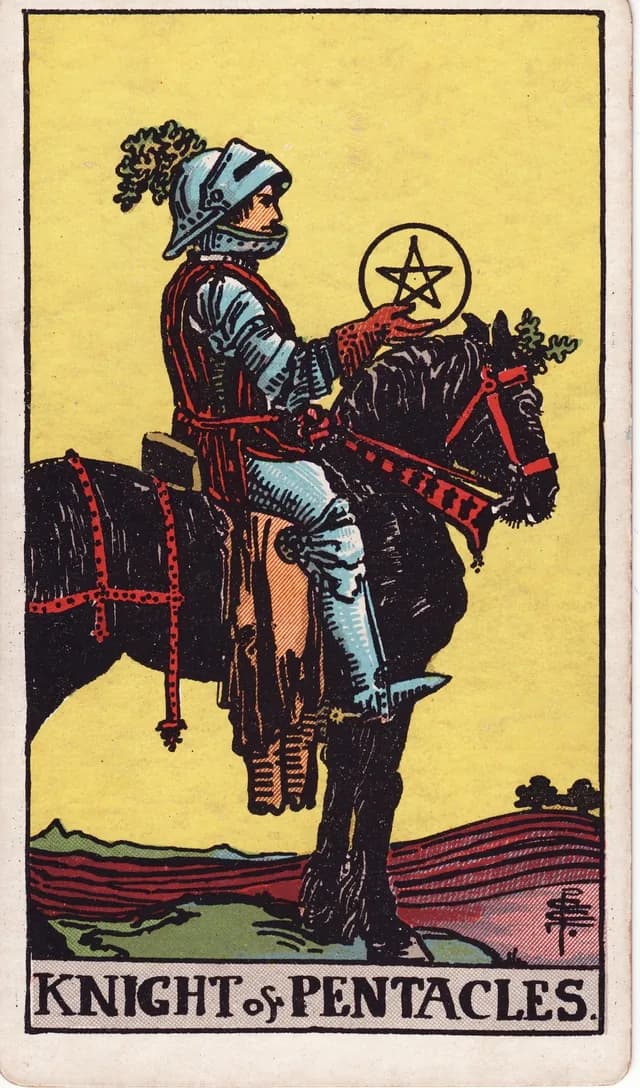
What Knight of Pentacles yes or no means
Upright: Maybe, because your steady progress still needs time.
Reversed: Leaning no, because your familiar approach has stopped moving forward.
Upright, the Knight of Pentacles receives Maybe in Naksham's current classification of yes or no answers. Its dependable effort supports your question without making an unfinished process ready on demand. Check whether the required pace fits the real task and the time actually available. The Knight's open answer distinguishes steady progress from a completed result that the card cannot promise in advance.
Reversed, the answer becomes Leaning no because a familiar approach has stopped producing useful movement. Repeating the same plan can consume your available time without resolving the obstacle ahead. Identify the stalled step and consider a limited change before committing to another identical cycle. Actual progress distinguishes patient effort from rigidity, giving both classifications a practical condition to examine before proceeding.
Explore Knight of Pentacles with your own draw
Your draw can reveal any card in the deck.
In love
For a question about developing a bond, upright Maybe asks whether steady contact supports your shared expectations. Agree what the next stage means before assuming that familiar meetings already point toward it. Reversed Leaning no highlights a routine that needs fresh attention before another promise is added. Neither answer confirms another person's feelings, so their stated wishes remain essential to deciding what happens between you.
At work
A recurring work task fits the upright Knight when a reliable process still produces useful progress. The Maybe answer asks you to compare the actual pace with the deadline rather than assuming readiness. Reversed Leaning no directs attention to rigid steps or neglected care that keep work stalled. Review a completed cycle before deciding whether continuing unchanged serves the task and the people relying on it.
Your next step
Write your question around one practical step and identify the evidence that would make it ready. Check what the current routine delivers, including the time each necessary stage actually takes. Let upright Maybe lead toward an honest timetable instead of a demand for immediate certainty. If reversed, test a specific adjustment before adding more effort to the same method that has stopped working.
- upright maybe
- reversed rigidity
- steady progress
- pace condition
The image behind this reading
Your gaze can trace the plowed fields stretching behind the horse’s legs across the lower scene.[1]
Read these meanings as modern interpretations of the imagery in your 1909 Rider-Waite-Smith deck.