
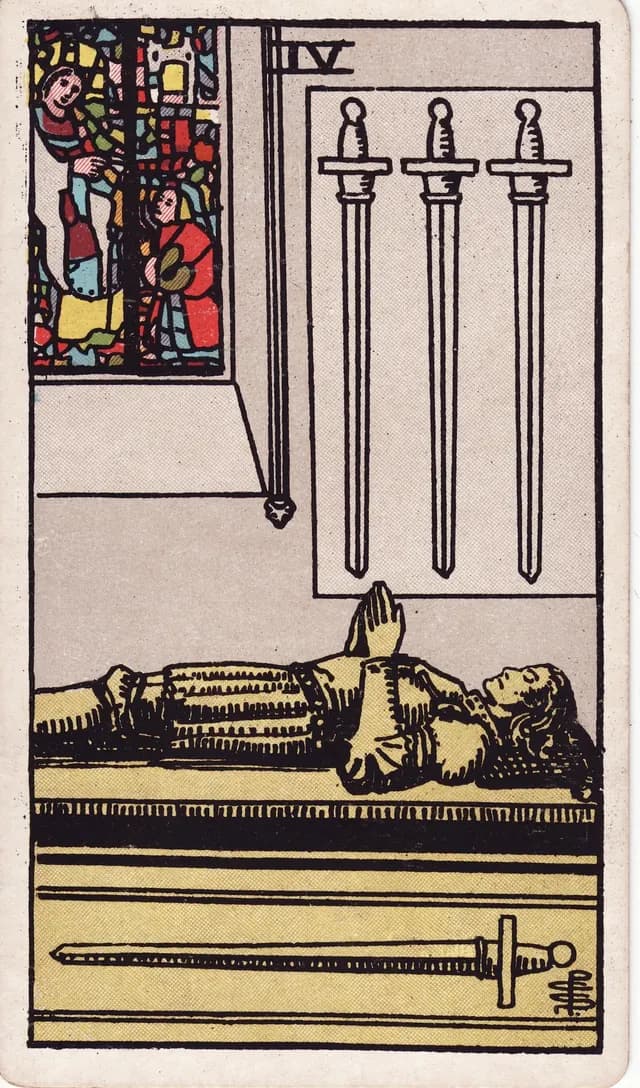
What Four of Swords reversed means
The reversed Four of Swords suggests your balance between stepping back and returning needs attention. Rest can feel difficult when thoughts keep rehearsing unfinished tasks despite an outwardly quiet schedule. A long pause can also become avoidance when one manageable step has become possible again. Read these as different situations to examine, rather than instructions to push through every tired moment.
Notice what happens when you consider a small return instead of resuming the full load. A modest task can clarify your present capacity better than a broad promise to restart everything. If even that task leaves little room to settle, review the demands before adding more. The resting figure anchors a question about pace, without making the card a measure of health.
Explore Four of Swords with your own draw
Your draw can reveal any card in the deck.
In love
A period of space can need a clearer next conversation once you are ready to reconnect. Ask whether both people want contact and agree on a manageable way to begin again. If the pause has no shared meaning, clarify its boundaries rather than assuming silence equals recovery. The reversed Four supports a thoughtful return without requiring immediate closeness or an end to needed rest.
At work
Returning to work after a break can bring pressure to prove your usefulness immediately again. Choose a limited set of tasks and agree on priorities before accepting the full backlog. If quiet time has become repeated avoidance, start with the smallest responsibility you can genuinely complete. The reversed Four asks for an honest pace, with capacity assessed through experience rather than pride.
Your next step
Compare what you planned to resume with what your present schedule can reasonably hold. Choose one small action and leave enough space afterward to notice how the pace feels. If the pause still serves a clear need, protect it with a stated boundary. If it has become directionless, give your next step a purpose beyond simply ending the stillness.
- restless pause
- gentle return
- uneven pace
- quiet limits
The image behind this reading
You see the resting figure with joined hands beneath three swords mounted on the wall.[1]
Read these meanings as modern interpretations of the imagery in your 1909 Rider-Waite-Smith deck.