
What Five of Cups yes or no means
Upright: No, because your view remains fixed on the loss.
Reversed: Maybe, because your next step needs room beyond the loss.
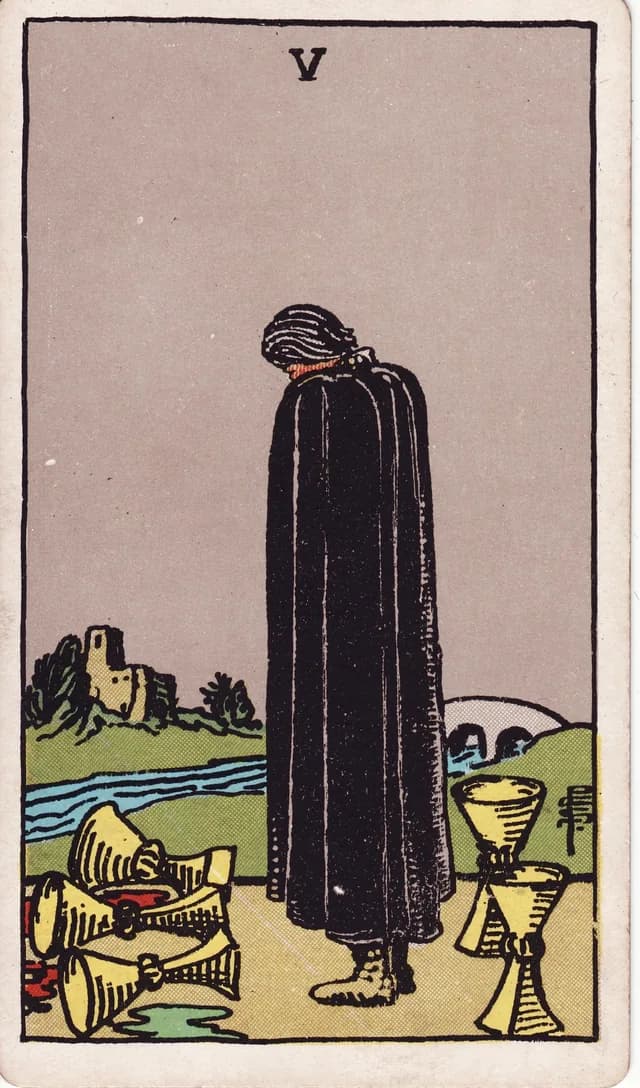
The Five of Cups upright receives No in Naksham's current map because disappointment dominates the view. Apply that answer to a choice you are considering mainly to undo a painful letdown. Check whether the proposal has present value beyond the hope of recovering the original outcome. The spilled cups invite perspective without predicting that every option considered during disappointment must fail.
Reversed, the answer remains Maybe as attention begins returning toward support and possibilities still available. Ask whether your next step uses something real or assumes the earlier loss can simply be reversed. A practical condition is naming one resource and one limit before promising a fresh commitment. The two orientations distinguish absorbed disappointment from returning attention without making either state a forecast of events.
Explore Five of Cups with your own draw
Your draw can reveal any card in the deck.
In love
For love, upright No asks whether pursuing contact is mainly an attempt to remove the pain of rejection. Check what the other person has actually said before treating renewed effort as a path to reassurance. Reversed Maybe leaves room to consider care when your present interest and the other person's willingness are clear. Neither label confirms reconciliation, and the next exchange must respect any boundary already stated between both people.
At work
At work, upright No highlights a decision dominated by the wish to erase an earlier setback. Review what failed before volunteering your time for an unchanged version of the same proposal. Reversed Maybe allows consideration of remaining skills and materials when the new scope is clearly defined. Check whether the next task offers useful work beyond proving the original effort deserved success.
Your next step
State the choice without mentioning what you hope it will undo from the earlier disappointment. List the current reasons for accepting, then note which reasons depend on recovering an outcome already lost. Use upright No to examine that attachment before adding another promise to the same unresolved situation. With reversed Maybe, identify one available source of support and choose a step small enough to assess honestly.
- upright no
- reversed maybe
- loss perspective
- practical recovery
The image behind this reading
Notice the three spilled cups near your left edge, with colored liquid spreading across the ground.[1]
Read these meanings as modern interpretations of the imagery in your 1909 Rider-Waite-Smith deck.