
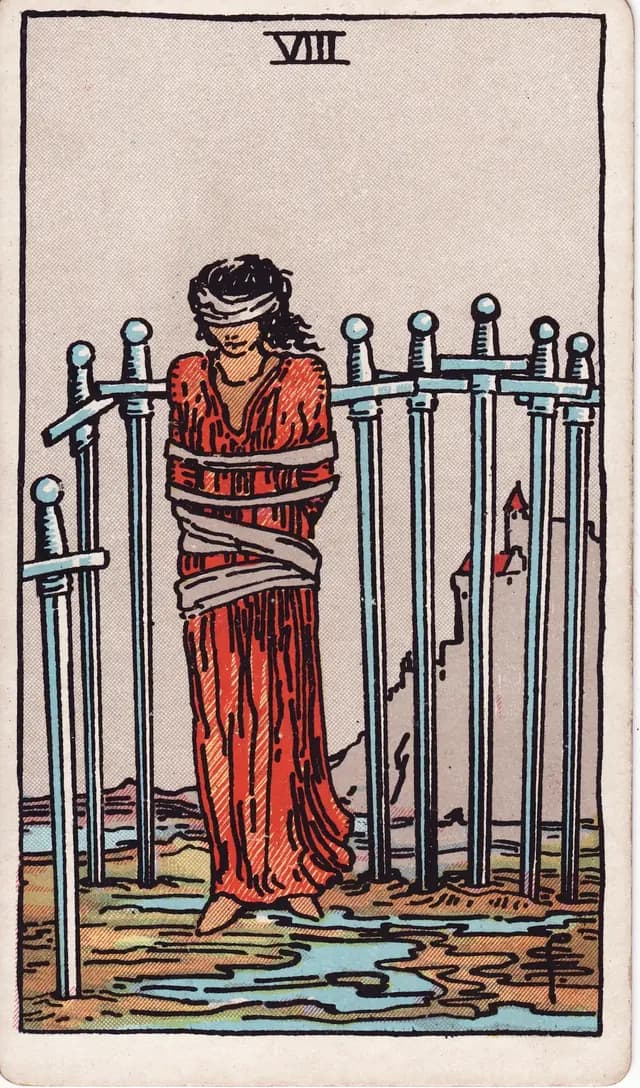
What Eight of Swords yes or no means
Upright: No, because you have not checked what limits your choices.
Reversed: Leaning yes, because you can now see a workable opening.
Upright, the Eight of Swords receives No because the restricted view makes the proposed action difficult to assess. Ask whether your decision depends on a limit that has been assumed rather than checked directly. The blindfolded figure offers an image for missing perspective, without proving that the surrounding restrictions are unreal. A clear next step requires enough information to understand the options and the conditions each one needs.
Reversed, the answer is Leaning yes because a newly visible opening makes a considered step more possible. That favorable direction needs a practical test, including what support your chosen option requires. Check the actual conditions instead of assuming that greater confidence has changed every outside circumstance. The labels follow separate current classifications, with each explanation distinguishing renewed choice from a guarantee of success.
Explore Eight of Swords with your own draw
Your draw can reveal any card in the deck.
In love
For a relationship decision, upright No asks you to clarify the choices before acting from a trapped feeling. State your need and check the existing agreement, including any boundary the other person has already expressed. Reversed Leaning yes can support a modest step when a real option becomes clear and freely available. Neither answer supplies consent or requires accepting a situation simply because leaving it feels difficult.
At work
An upright No can prompt you to check the assumption keeping a work decision narrowly framed. Read the current requirement or speak to the person able to explain the options honestly. Reversed Leaning yes favors examining a verified route, with the next step kept proportionate to available support. A useful opening should survive that practical check rather than depend only on feeling less doubtful.
Your next step
Choose one proposed action and write the limit you believe prevents it from being possible. Gather the fact that would confirm or challenge that limit before making a larger commitment. If an opening appears, define the smallest useful step and the conditions required to take it. The Eight turns its answer into a check on perspective, with real circumstances kept visible throughout the decision.
- upright no
- reversed opening
- tested limit
- renewed agency
The image behind this reading
You see eight upright blades around the figure, with the distant castle visible beyond them.[1]
Read these meanings as modern interpretations of the imagery in your 1909 Rider-Waite-Smith deck.