
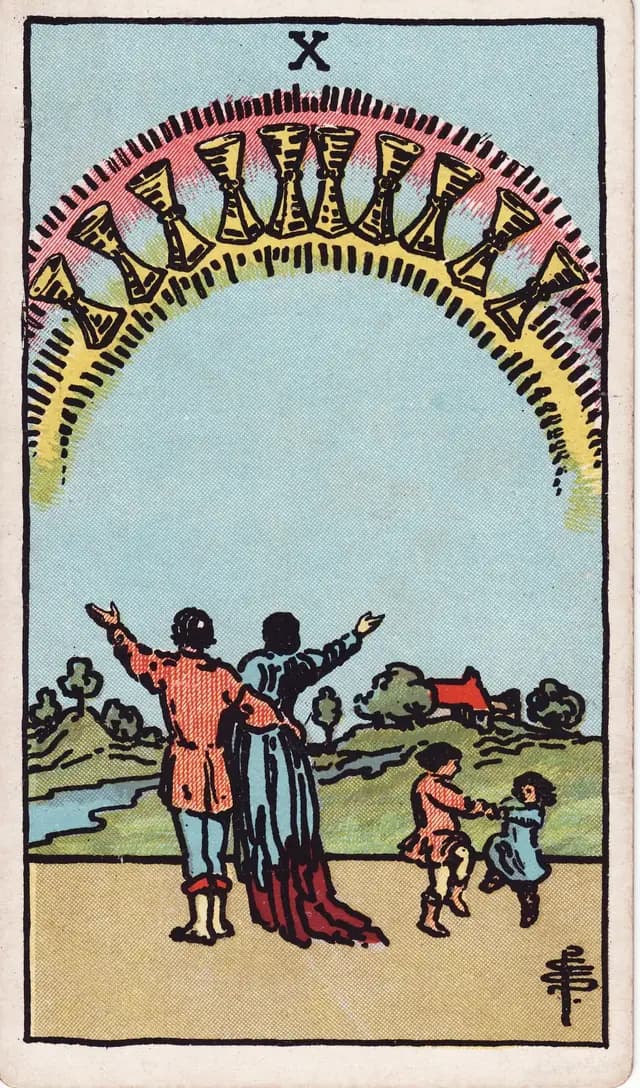
What Ten of Cups yes or no means
Upright: Yes, because your choice supports a shared sense of home.
Reversed: Leaning no, because your shared peace needs honest repair first.
The Ten of Cups upright receives Yes in Naksham's current map, favoring shared happiness and belonging. Apply the answer to a choice whose daily arrangements you and the others involved freely welcome. Check that the plan includes ordinary responsibilities rather than only the pleasure of imagining everyone together. The rainbow's favorable frame concerns shared care, with real participation needed before the proposed choice becomes an agreement.
Reversed, the answer is Leaning no because strained closeness makes the shared picture harder to sustain. Ask whether your next step addresses an existing disagreement or simply requires everyone to smile around it. A useful condition is agreeing how one repeated household pressure will be handled differently. These separate classifications compare supported belonging with unresolved strain, without forecasting a family's future or guaranteeing lasting happiness.
Explore Ten of Cups with your own draw
Your draw can reveal any card in the deck.
In love
For love, upright Yes fits a mutually wanted step that supports the life you already share. Discuss its practical effect on both people before allowing a favorable card to replace agreement. Reversed Leaning no highlights pressure to appear happy while an important need remains outside the conversation. A larger promise deserves careful discussion when daily closeness already depends on keeping that need quietly hidden.
At work
At work, upright Yes supports considering arrangements that help your team cooperate without repeatedly sacrificing home time. Check the proposed hours and coverage rather than relying on a broad assurance about workplace family. Reversed Leaning no asks whether another commitment would deepen tension between professional demands and personal relationships. Compare the actual schedule with the life it must support before accepting the invitation being offered.
Your next step
State the choice as one shared arrangement and ask who would carry its practical demands. List what improves belonging for you and what could make another participant's daily life harder. Use upright Yes to examine a plan whose care reaches beyond the happiest person involved. With reversed Leaning no, resolve one unspoken expectation before adding another commitment to the same strained routine.
- upright yes
- reversed leaning no
- shared wellbeing
- household agreement
The image behind this reading
Notice the winding river behind the adults as you look toward the green fields and distant house.[1]
Read these meanings as modern interpretations of the imagery in your 1909 Rider-Waite-Smith deck.